September 20, 2026
Do Hiring Managers Prefer Internal Referrals Over Outside Applicants?
Do hiring managers prefer internal referrals over outside applicants? Yes, and anyone who tells you otherwise has never sat on the hiring side of the table. You did everything right. You tailored the resume, you wrote the cover letter, you applied within a day of the posting going live. You heard nothing. Meanwhile somebody you know applied for a similar role, mentioned that a friend works there, and had an interview within the week.
The difference was not the resume. It was who read it, and how soon.
Seven Out Of A Hundred Apply This Way. Nearly Half Get Hired.
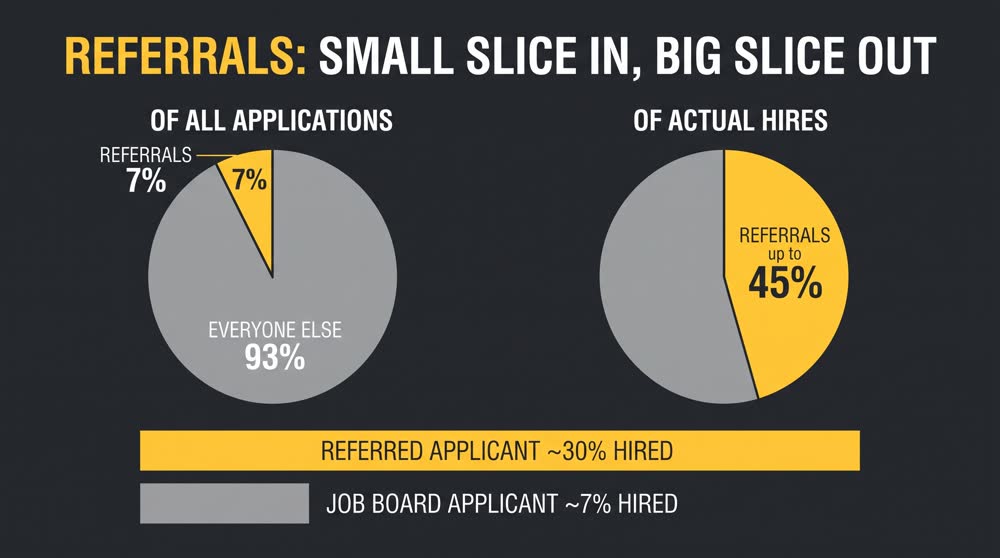
Picture the pile on a recruiter's desk. Out of every hundred applications that arrive for a role, roughly seven come in with somebody inside the company attached to them. The other ninety three arrive cold. Now look at who actually gets hired. Depending on the company, referrals account for anywhere from thirty to forty five out of every hundred hires.
Sit with what that means. A tiny sliver of the applications produces close to half the hires. Put another way, if you apply through a job board, roughly seven out of a hundred people in your position end up hired. If somebody inside refers you, closer to thirty out of a hundred do. Same resume, same person, four to ten times the odds.
This is not favouritism dressed up as process. It is a company doing the maths. A referred hire costs less to find, somewhere around one to three thousand rather than nearly five thousand. They start sooner, about twenty nine days from application to offer instead of fifty five. And they stay. Three years on, close to half of the referred hires are still there, against about a third of the job board hires. If you were the one holding the budget, you would push referrals too.
What Actually Happens The Moment A Referral Lands
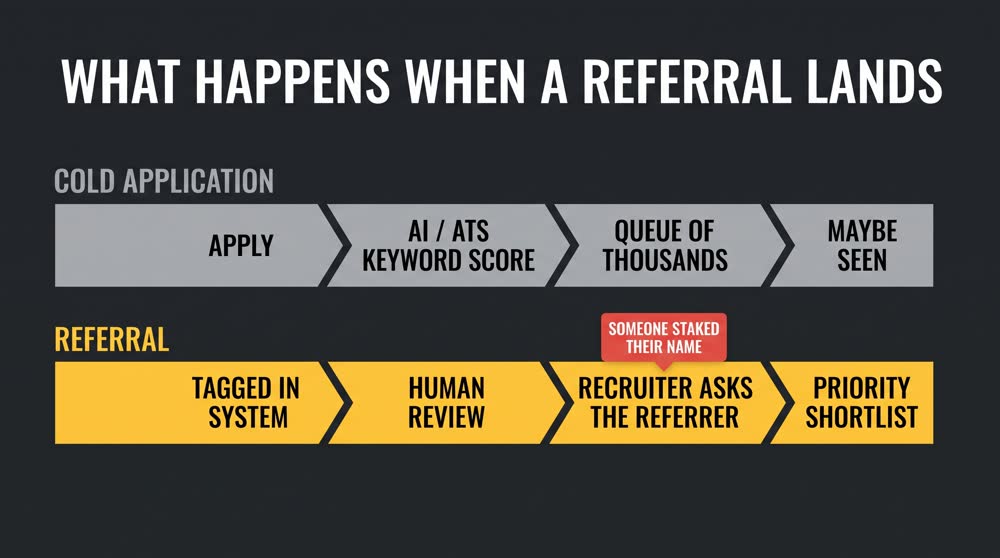
Here is the part nobody explains from the outside. A referral does not go into a different system. It goes into the same system, with a flag on it.
That flag changes who reads it. A cold application usually meets software first. The system scores you on keywords, job titles and years of experience, then drops you into a queue with a thousand other people. If your background is at all sideways, if you switched industries or took an unusual route, the software has no way to understand that, and you are filtered out before a person ever looks at you.
A referral gets lifted out of that queue and read by a human being. The recruiter often has an internal target to review referrals within days, because referral numbers get reported upward. The hiring manager tends to see referred candidates earlier, in a priority section rather than buried in the main list.
Then comes the part that really moves things. Somebody will go back to the person who referred you and ask, how well do you know them, what are they good at, any concerns. That is a reference check happening before you have even interviewed, and it is free information the hiring manager gets about you and nobody else. If the person vouching for you has a reputation for good judgement, that one conversation can be enough to win you a first interview. If they refer everyone they have ever met, it carries almost nothing.
A Fast Lane, Not A Teleport
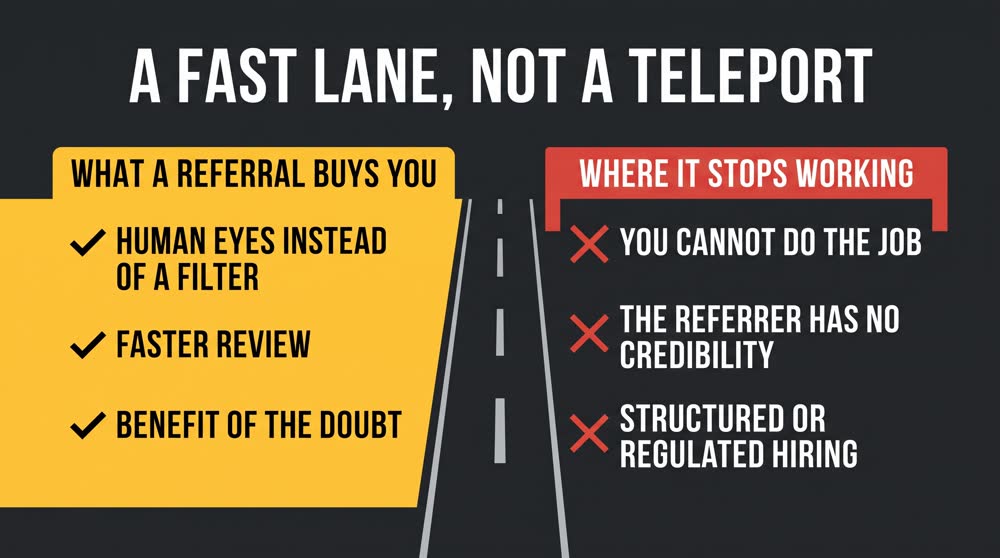
It is worth being straight about what a referral does not do, because people load too much weight onto it and then feel cheated.
A referral buys you human attention. It does not buy you the job. If you cannot do the work, the referral tag does not override that, and the hiring manager will pass, sometimes faster than they would on a stranger, because now a colleague's judgement is attached to the decision. A referral into the wrong role gets redirected, not forced through. And in structured hiring, which is where government, unionised and regulated processes sit, a referral cannot jump a ranked list or a required test score.
There is a cost on the company's side too, and good hiring managers know it. Referrals travel along networks that already exist, so a company hiring mostly through referrals tends to keep hiring the same kinds of people from the same schools and the same previous employers. That is why many organisations now cap referral bonuses, pay them out only if the hire stays six to twelve months, and deliberately weigh referral numbers against the people they are not reaching.
So take a referral for what it is. It puts your file in front of a person instead of a filter. Everything after that is still yours to earn.
No Contact Inside? Build One.
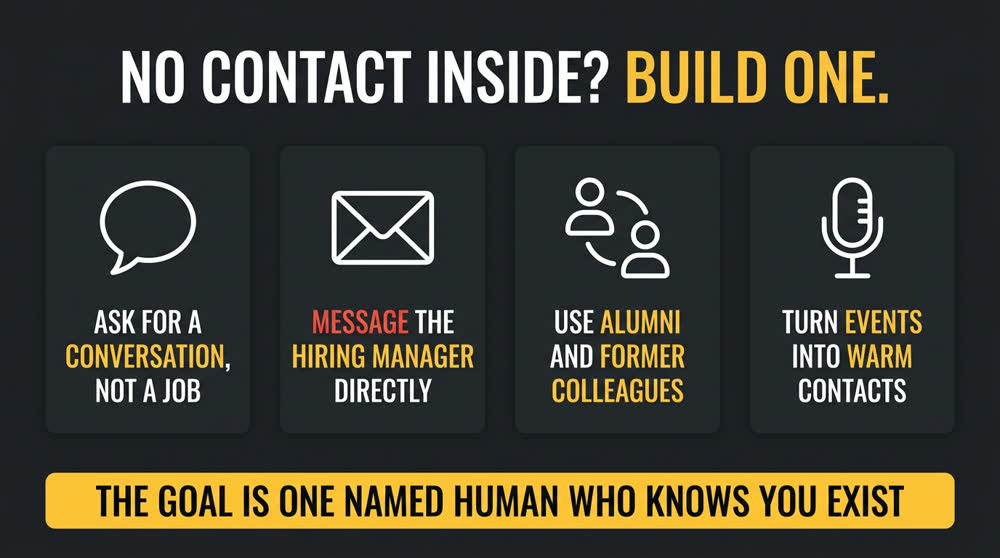
Most people read all of this and think, fine, but I do not know anyone there. That is the wrong conclusion. What a referral really delivers is one named human inside the process who knows you exist and thinks you are worth a look. You can build that yourself.
Ask for a conversation, not a job. Find somebody doing the role you want, at that company or one like it, and ask for fifteen minutes to understand the work. Most people say yes, because you are asking about them rather than asking them for a favour. You come away knowing what the team actually needs and the words they use for it, which is what lets you write an application that lands. Sometimes that person offers to refer you. Do not ask for it in the first message.
Write to the hiring manager directly. Keep it short, specific to the role, and show you understand what that team is dealing with. Hiring managers do read these when application volume is high, precisely because the volume is exhausting. A manager asking the recruiter to pull your file out of the system produces the exact same effect as a referral. You have simply referred yourself.
Use the people you already have. Former colleagues, people from your course, anyone in your industry association. A second degree connection who mentions your name to the recruiter is worth more than another cold application. And treat talks, webinars and industry events as what they are, a room full of people who work where you want to work, and where a follow up message is normal rather than intrusive.
None of this is about knowing the right people from birth. It is about making sure that before your application arrives, one person inside is in a position to say, I know who that is, take a look.
One Thing To Do This Week
Pick one company you actually want to work for. Find one person there doing the job you want. Ask them for fifteen minutes about the work, not for a job. That is the whole task.
Do it four more times and you will never apply cold again.