September 4, 2026
How Hiring Managers See Career Breaks and Employment Gaps
How hiring managers see career breaks and employment gaps is the question I get asked more than almost any other, and it is almost always asked in a slightly embarrassed voice. There is a gap on the resume. Eleven months. Two years. Four. And the person in front of me has spent more energy trying to disguise those months than they spent on the rest of the document.
One in Ten Will Reject You. Three in Ten Will Not Blink.
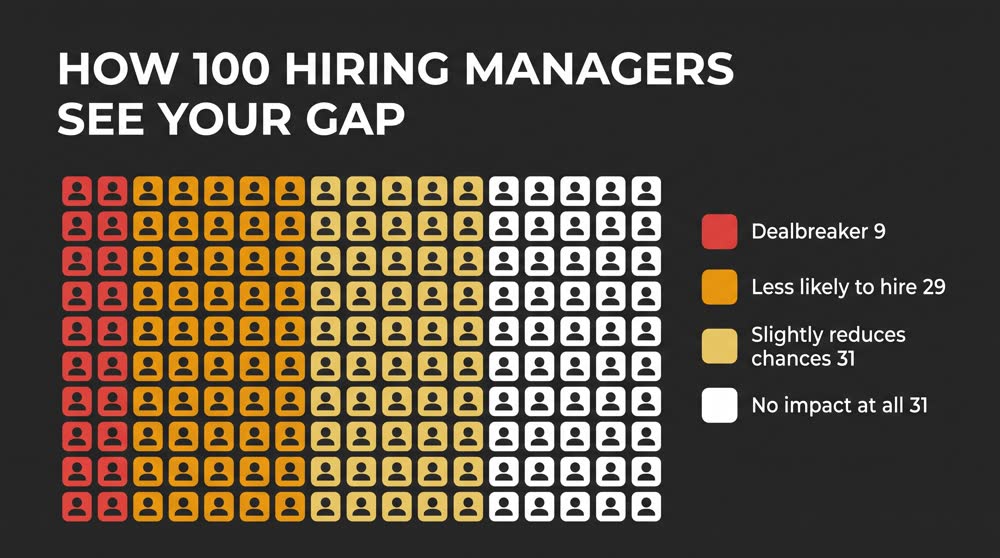
Here is the honest split. When hiring managers were surveyed about employment gaps, about 9 out of 100 called a gap a dealbreaker. Around 29 out of 100 said it made someone less likely to be hired. Another 31 said it slightly reduced the chances. And 31 said it made no difference at all.
Round that off and you get a useful picture. Roughly one manager in ten will screen you out on sight. About three in ten are genuinely cautious. The rest are waiting to hear the story.
In a separate survey of more than 500 hiring decision makers, 92 out of 100 agreed there are perfectly acceptable reasons for a career gap. Going back to study was the most accepted at 68 out of 100, then staying home with a child at 66, health issues at 64, and caring for an elderly parent at 63. What actually deterred them was not the gap. It was an unexplained one. About 36 out of 100 said that was the thing that put them off.
So the gap itself is rarely the problem. The silence around it is.
The Software Does Math, Not Judgment
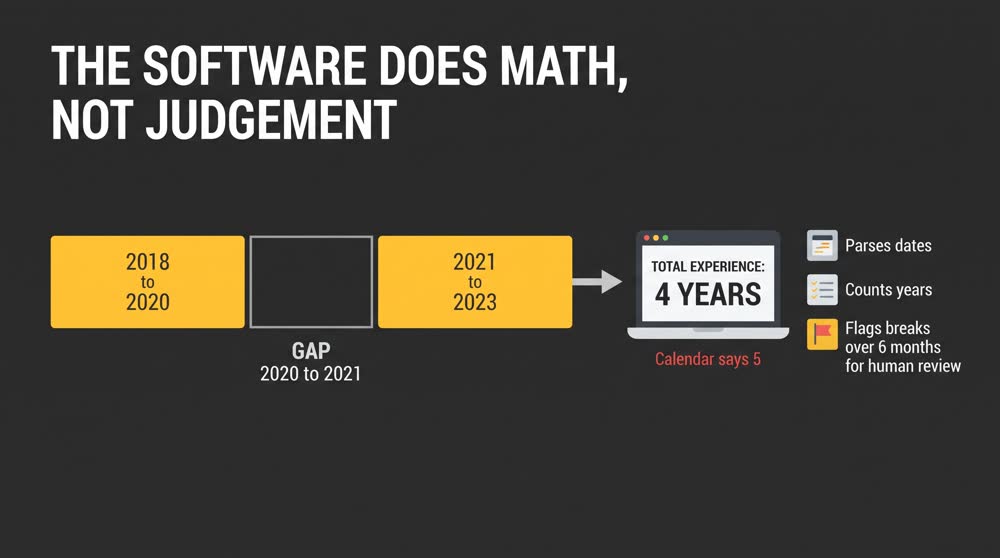
A lot of people picture the applicant tracking system as a bouncer that spots a gap and throws the resume in the bin. That is not what happens. No mainstream system has a rule that automatically rejects you for a break.
What it does is arithmetic. It reads your dates, works out how long you spent in each role, and adds up your total years. If you worked 2018 to 2020, took a year out, then worked 2021 to 2023, the system counts four years of experience. Your calendar says five. The filter says four.
That is where the quiet damage happens. When a recruiter filters for "5+ years", your break can push you under the line before a human being has read a single word you wrote. Some setups will also flag a break longer than six or twelve months for review, but a flag is an invitation to look, not a rejection.
The decision about your gap is always made by a person. The software only decides whether that person ever sees you.
Silence Costs More Than the Gap Itself
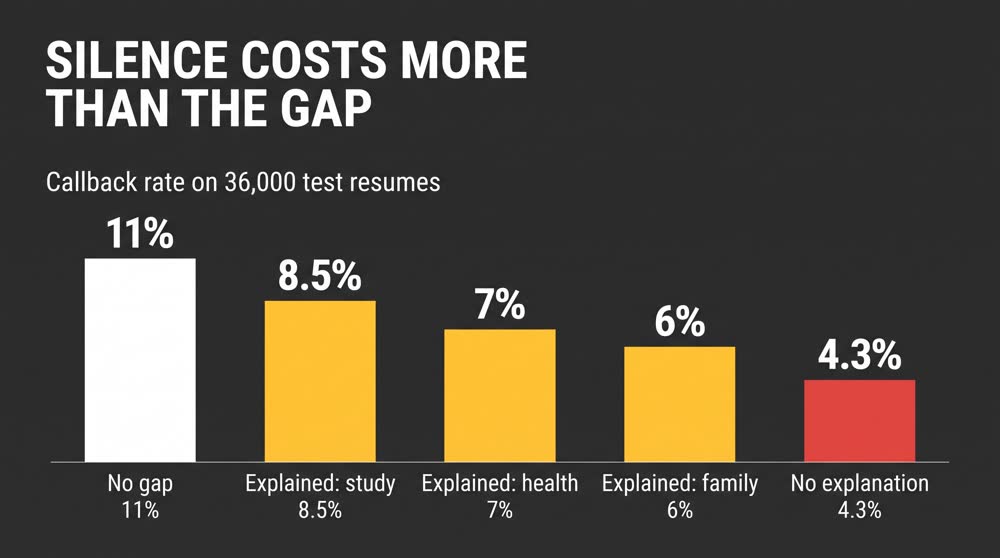
The largest study I know of on this sent roughly 36,000 test resumes to real job openings and measured who got called back. Resumes with no gap at all got a callback a little over 11 times out of 100. That is the baseline.
Then it gets interesting. A gap with no explanation attached dropped the callback rate to 4.3 out of 100. A gap explained as time spent studying pulled it back up to 8.5. Health reasons, around 7. Family reasons, close to 6. One sentence of context roughly doubled the response rate compared with saying nothing at all.
Length matters too, and more than most people expect. A break of one to two years barely moved the number, around 10 out of 100. At three years it fell to 4.6. At four years, 3.7. At five years, 3.1. A short break is close to free. A long one is expensive, and a long unexplained one is the most expensive combination on the list.
There is a formatting finding worth knowing as well. A UK trial across more than 9,000 real applications found that listing years of experience instead of exact month-by-month dates lifted callbacks by around 15 percent compared with a standard dated resume. That is not a trick. It is a format that stops a small gap from dominating a six second scan.
The Four Sentences That Close It
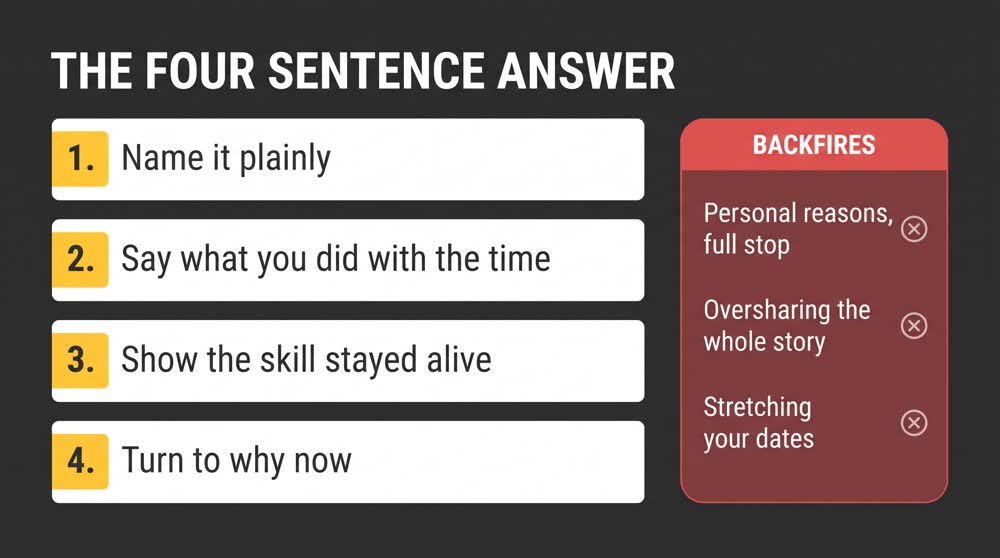
When I asked about a gap in an interview, I was not fishing for a confession. I was listening for judgment, and for whether you were ready to work now. That takes about four sentences.
Name it plainly. "I took fourteen months out to care for my father after his surgery." No euphemism, no apology. Say what you did with the time. A certificate, freelance work, a volunteer project, a course, anything that shows those months had a shape. Show the skill stayed alive. One concrete example is enough. Turn to why now. "That season is finished, and I am ready to be back in a full-time role doing this work."
Placement matters. On the resume, a single line entry does the job: "Career break, caregiving, 2024 to 2025", with one line underneath it. The cover letter is the right place for two or three sentences of narrative. On LinkedIn, use the Career Break field, because around half of employers say they are more likely to contact someone once they understand the reason. That label is quietly working for you.
Four things backfire. Saying "personal reasons" and stopping there, because it invites the worst assumption in the room. Oversharing the medical or family detail, which makes a manager quietly worry about the next disruption. Blaming a previous employer at length. And stretching your dates to close the gap, which is the one item here that reliably ends a process, because background checks find it and dishonesty is treated far more seriously than any break ever was.
What Changed Since 2020, and What Did Not
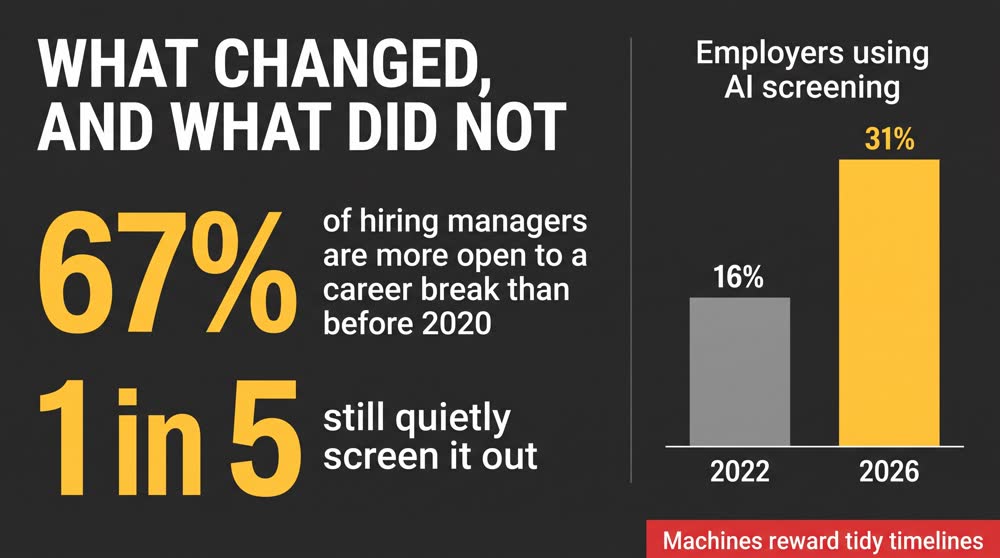
Something genuinely shifted. In LinkedIn's survey of hiring managers, 67 out of 100 said they were more likely to hire someone with a career break than they were before the pandemic. The layoff waves did that. When whole teams disappear at once, a gap stops looking like a personal failing.
But roughly 1 in 5 hiring managers still admit they reject candidates who have taken a break. And 65 out of 100 workers still believe the stigma is there, which is exactly why so many people hide something most of the room would have accepted.
The newer pressure is automated screening. About 31 out of 100 employers now use AI or machine learning somewhere in hiring, up from around 16 out of 100 in 2022. These tools are not judging your break morally. They reward tidy, linear timelines and strong keyword matching, which quietly disadvantages anyone whose career has a real-life shape to it. The defence is the same as it always was: clean dates, strong keywords, and a break that is labelled rather than left blank.
One more thing, said plainly. The research on the motherhood penalty is consistent and uncomfortable. Mothers are rated as less committed and less promotable than equally qualified colleagues, and that bias sits underneath the gap conversation whether anyone names it out loud or not. Explaining your break well does not dissolve that. What it does is remove the one objection a cautious manager can defend in front of other people.
Your gap is not the thing standing between you and the offer. The empty space where the explanation should be is.