August 14, 2026
How Promotion Decisions Are Really Made Inside Companies
The Decision Is Made Before Anyone Talks to You
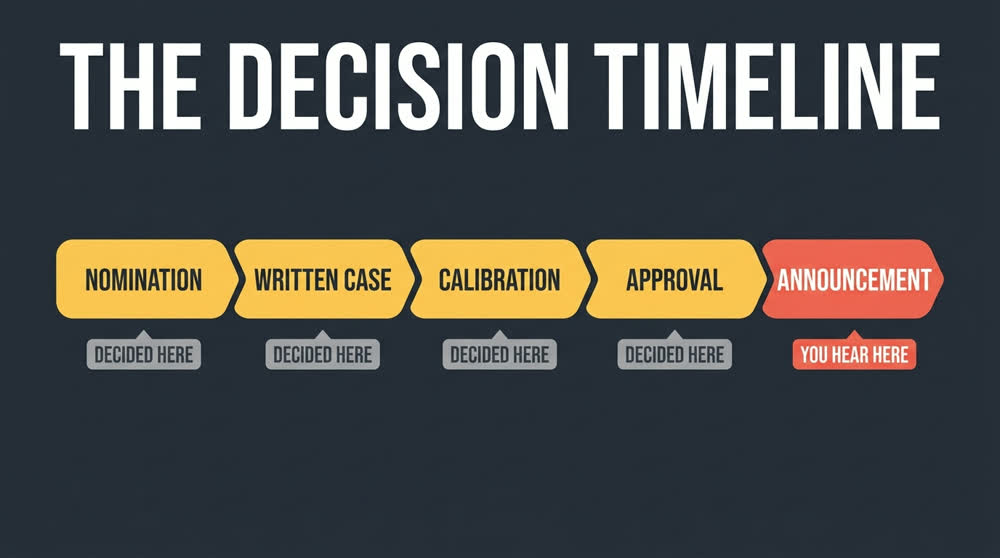
If you have ever walked out of a promotion conversation feeling like the answer was already written down somewhere, you were right. How promotion decisions are really made inside companies has very little to do with the conversation you are having, and almost none of it happens in front of you.
A typical cycle runs in four moves. Your manager nominates you, or you push to be nominated. A written case gets built, documenting your scope, your outcomes and the feedback of people you work with. That case goes into calibration, where managers compare their candidates against a shared bar. Then it goes to an approval layer that usually includes your skip level leader, an HR or People partner, and often Finance, because a promotion changes your pay position inside a salary band.
By the time the formal meeting happens, most outcomes are already largely settled. The committee is not re-reading your career. It is checking whether the case written about you holds up next to the other cases, and whether it fits the company's leveling, budget and headcount plan.
That is the first thing to absorb. You are not being judged in the room. A document about you is.
The Bar Is Not "Ready." It Is "Already Doing It."
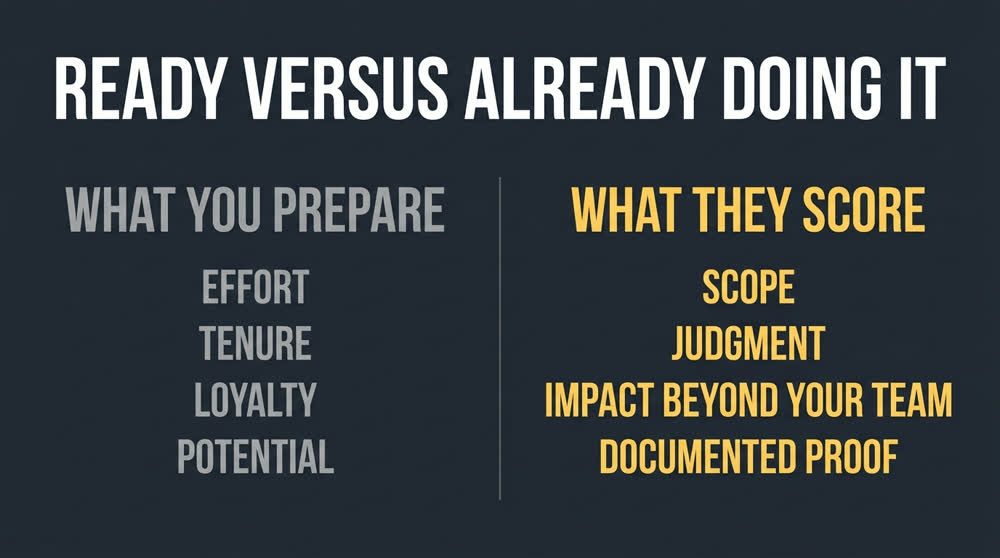
Most people prepare for a promotion by proving they are ready for it. Companies promote people who are already doing the work of the next level.
Almost every internal promotion process asks the same question in some form: is there evidence this person is operating with the scope, judgment and impact of the level above? Potential is supporting evidence. Demonstrated scope is the deciding evidence.
The practical test is uncomfortable but clarifying. If the only real difference between you and the next level is the title, you have a case. If the difference is that you would grow into it, you have a hope. Those are two very different things in a calibration room, and only one of them survives comparison with a peer who is already operating there.
So the work is not to argue that you deserve the level. It is to take on the smallest piece of next level scope you can actually get your hands on now, and to do it visibly, months before the cycle opens.
Why Good People Get Told "Next Cycle"
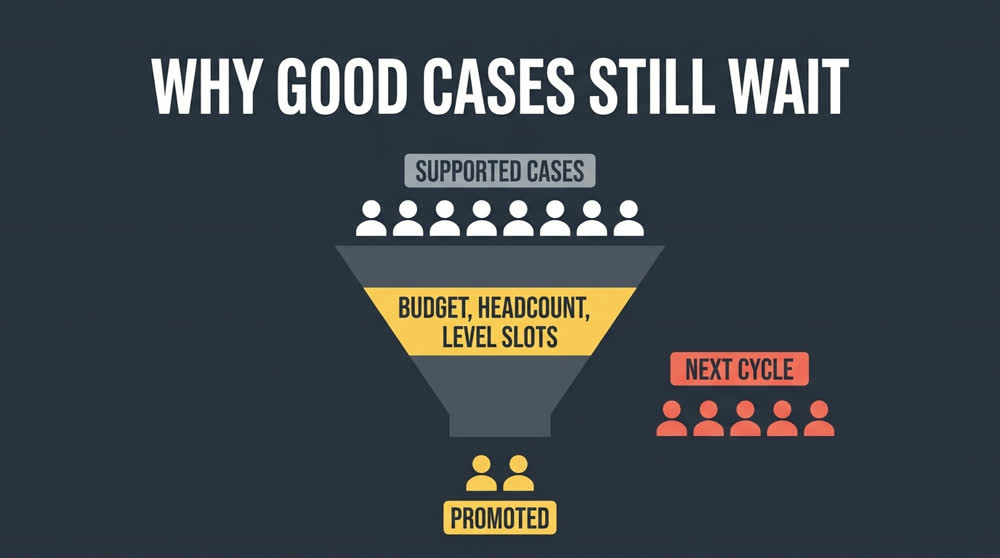
Here is the part nobody says out loud. A promotion is not a merit award. It is a constrained allocation.
Even when your manager supports the case and the evidence is strong, the decision still has to clear a salary band, a headcount plan and a budget. HR and Finance sit in that approval chain for exactly that reason. Companies also compare candidates against each other, which means the bar is not fixed. It moves with whoever else is up that cycle.
There is a second factor most employees never consider: the company itself. Workforce data firm Revelio Labs tracks what it calls promotion intensity, the number of internal promotions per 100 employees per year, and it varies sharply from company to company. A strong performer inside a low promotion company can wait considerably longer than an equally strong performer somewhere else. That is not a story about your performance. It is a story about where you are standing.
So when you hear "next cycle," ask one specific question: what would have to be different for the answer to be yes? If the answer is concrete and about your work, you have a plan. If the answer is vague or structural, you have just learned something important about the company, not about yourself.
Someone Has to Argue for You
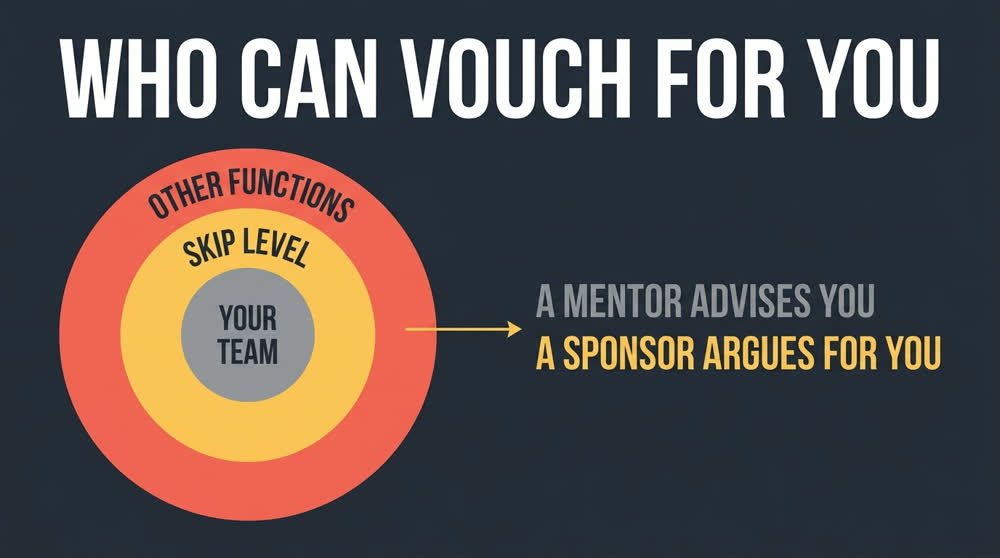
In the room where your case is discussed, you are not there to explain yourself. Someone else has to do it, and how well they do it depends on how many people in that room already recognise your name.
This is the difference between a mentor and a sponsor. A mentor advises you in private. A sponsor spends their own credibility arguing for you in public. The people who matter most are your direct manager, your skip level leader, and the other leaders sitting in calibration, because they control how your case gets interpreted next to everyone else's.
If your impact is only visible inside your own team, your manager is your only witness. That is a fragile position. The people who move most reliably are the ones whose work is known one or two layers up and across other functions, so that when their case is read out, two or three people in the room can independently confirm it.
You do not need politics for this. You need normal, repeatable visibility: showing your work in forums where senior people are present, volunteering for the project that crosses team boundaries, and building enough trust with partner functions that they will say good things about you when nobody asked them to.
Undocumented Work Loses
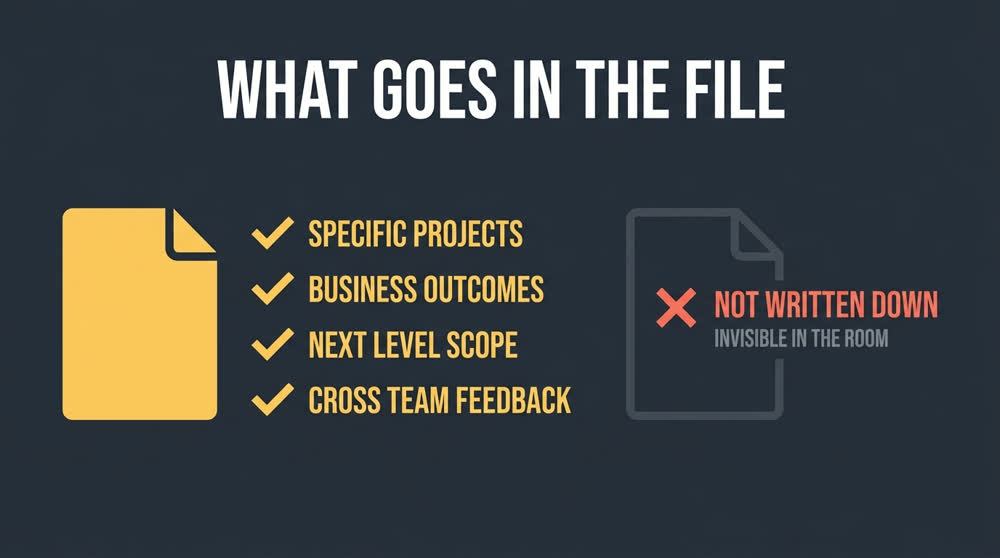
A promotion case is not a resume. It is closer to a legal brief. The company is not asking what you remember about your year. It is asking what can be proven.
A solid case contains specific projects, the business outcome attached to each one, clear evidence of next level scope, and corroboration from peers or cross functional partners. Anything outside that document effectively did not happen. If the work was not written down, not repeated by the people who benefited from it, and not remembered at calibration, it is invisible at the exact moment it matters.
The fix is unglamorous and it works. Keep a running evidence file all year. One line each time something changes because of you: what you did, what changed as a result, and who saw it. Hand it to your manager before the nomination window, not after the decision.
Your manager is writing the most important document of your year either way. The only question is whether you gave them anything to write with.
Promotions look like recognition from the outside. Inside the building, they are a comparison, a budget and a piece of paper. Once you can see that, you stop preparing for a conversation and start preparing the case.