July 24, 2026
The Questions You Ask at the End of the Interview Are Being Scored
You've been talking for forty-five minutes. You handled the behavioral questions. You gave a decent answer about the gap on your resume. Then the hiring manager glances at the clock and says the line everyone says: "We're just about at time. Do you have any questions for us?"
And you say, "No, I think you've covered everything."
That moment feels like the interview ending. It isn't. From where I sat, on the other side of the table, it was the interview starting to be scored.
The Last Five Minutes Are the Ones I Wrote Down
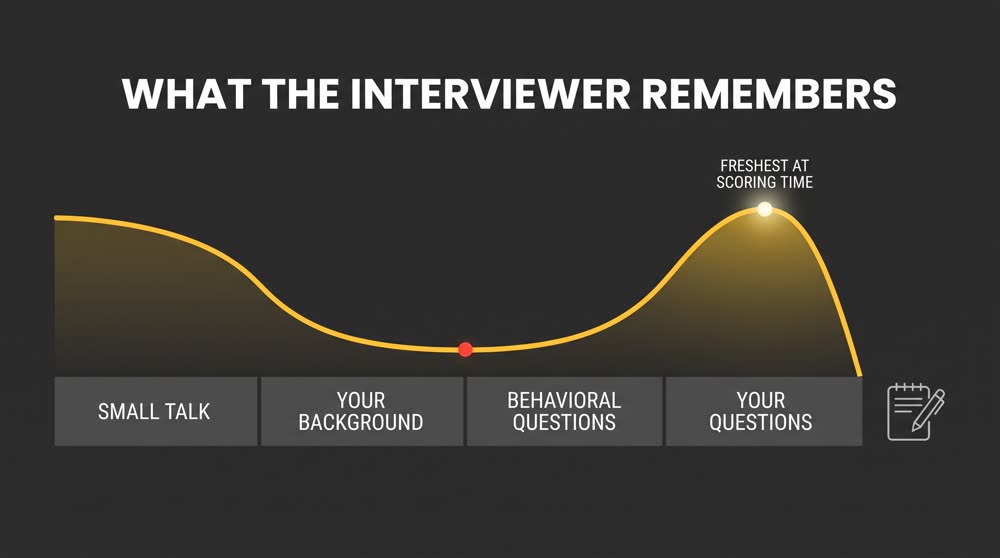
Here's what actually happens after you leave the room or the call drops. The panel doesn't sit and carefully replay the whole conversation. Most of us wrote our notes within about five minutes, usually between back-to-back meetings, often while walking somewhere. Whatever happened last is what was still loud in our heads.
Psychologists call this the recency effect. Whatever comes at the end of a sequence gets weighted more heavily when someone forms an overall impression. In an interview, the very last thing that happens is your questions. They are literally the final data point an interviewer sees before writing you down.
That's why your questions punch so far above their weight. Not because anyone thinks they matter more than your actual experience, but because of when they happen. Your best answer of the day was thirty minutes ago. Your questions were thirty seconds ago.
I want to be honest about how this works, though. Very few companies have a line on the scorecard that says "quality of candidate questions." What they do have is a line for interest, motivation, preparation, or engagement. Your questions are the main evidence anyone has for scoring those. It's an unofficial score, and it's real.
"No Questions" Is Itself an Answer
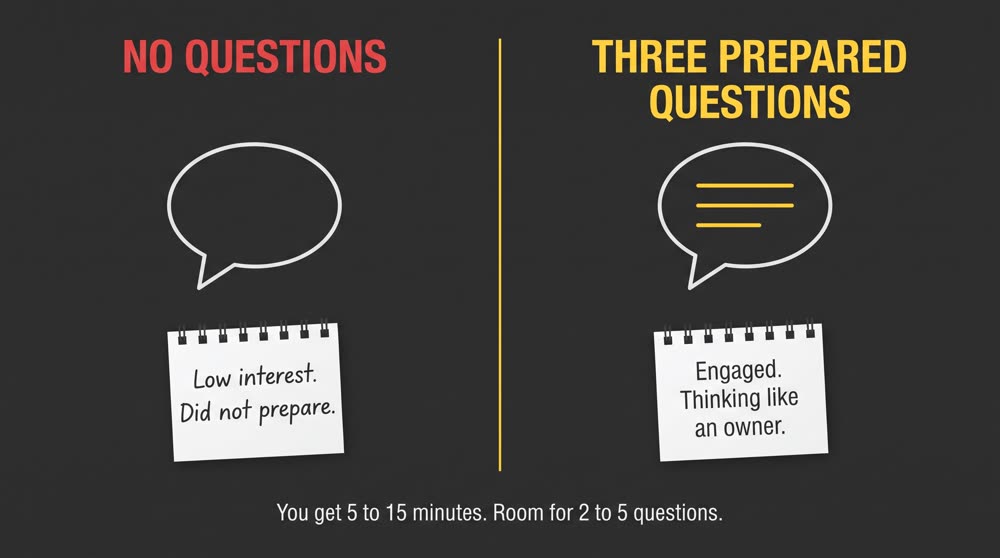
Candidates who say "no, you covered everything" usually think they're being efficient and respectful of the interviewer's time. I have never once seen it read that way in a debrief.
It reads as low interest, or as not having prepared. And here's the uncomfortable part: for any role that involves curiosity, client contact, or working across teams, having no questions isn't neutral. It becomes evidence against you. You just spent an hour learning about a job you'd do every day for years, and nothing about it made you curious enough to ask.
Notice how much space career advice gives to warning people about this. Every major interview guide has a section on it. That tells you something about how often it happens.
Practically, you'll usually get somewhere between five and fifteen minutes at the end, which is room for two to five real questions. So prepare more than you'll use. Six to eight is a good number. Then pick the ones that fit what actually got discussed, and drop the rest. Walking in with eight and asking three is preparation. Walking in with three and asking all three, including the one they already answered, is a script.
Four Questions That Move You Up the List
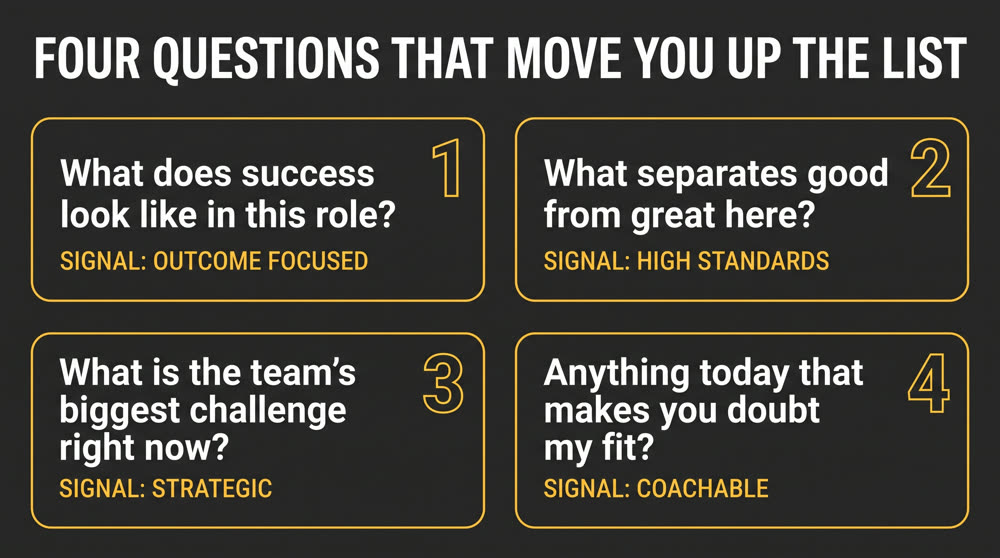
The best questions all share one trait: they make the interviewer picture you already doing the job. Here are four that consistently did that.
"What does success look like in this role, and how will it be measured?" This is the strongest one. It shifts the conversation from whether you can do the work to what the work would actually produce. Managers care enormously about outcomes, and this question speaks their language. It also gets you genuinely useful information about whether the expectations are realistic.
"What separates someone who is good in this role from someone who is great?" This tells the interviewer you're not aiming for adequate. It's also the single most revealing question you can ask, because the honest answer exposes what the team truly values, which is often different from what the job description says.
"What's the biggest challenge the team is facing right now?" This one requires you to have done enough homework that you're asking about their situation, not the industry in general. It signals that you think about context, not just tasks.
"Is there anything I've said today that makes you doubt I'd be a good fit?" This takes nerve, and it's worth it. It signals confidence and coachability at the same time. More importantly, it's your one chance to fix a misunderstanding before it hardens into a debrief note. If they say something, you get to answer it. If you never ask, that doubt goes in the file unchallenged.
The Questions That Quietly Cost People the Offer
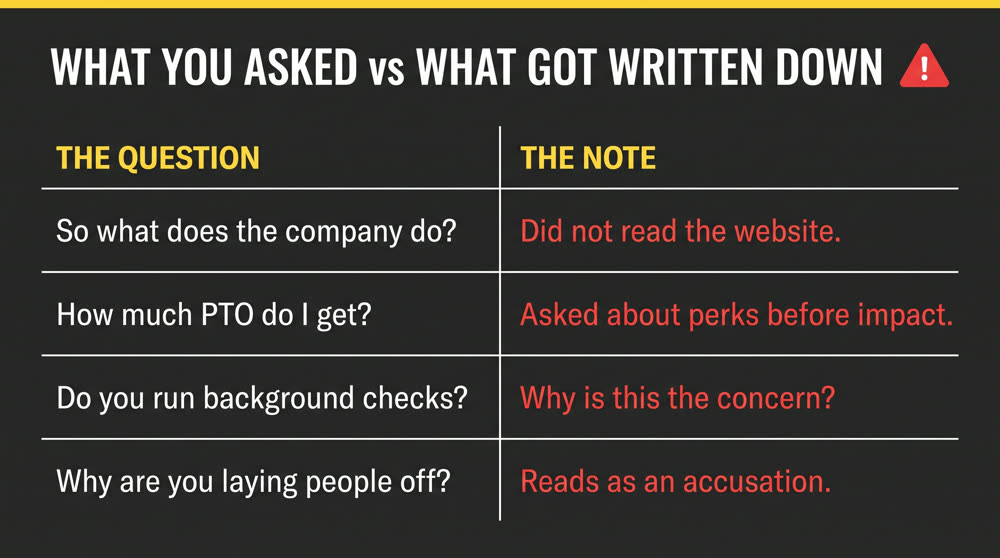
Some questions do more damage than asking nothing at all. These are the ones I saw sink otherwise solid candidates.
Anything answered on the careers page. "So what does the company do?" or "Who are your main competitors?" You can find that in four minutes. Asking it says you didn't spend the four minutes.
Money, time off, and promotion timing before there's an offer. These are completely legitimate things to care about, and you absolutely should get answers before you accept anything. The issue is sequence, not substance. Asked at the first-round stage, they read as someone deciding on perks before they've shown any interest in the work. Save them for the offer conversation, where you have leverage and where they're expected.
Questions about background checks. Innocent question, terrible optics. It makes people wonder what prompted it.
Layoff rumors framed as an accusation. "Why are you about to lay off a thousand people?" puts the interviewer on the defensive instantly. If you want to know, and you should, ask it forward-looking instead: "How is the team positioned for the next year or two?" You get the same information without making anyone flinch.
Filler questions asked just to have one. A vague "what do you like about working here?" asked with no connection to anything discussed is barely better than silence. Interviewers can tell the difference between curiosity and box-checking.
AI Can Write Your Questions. It Cannot Read the Room.
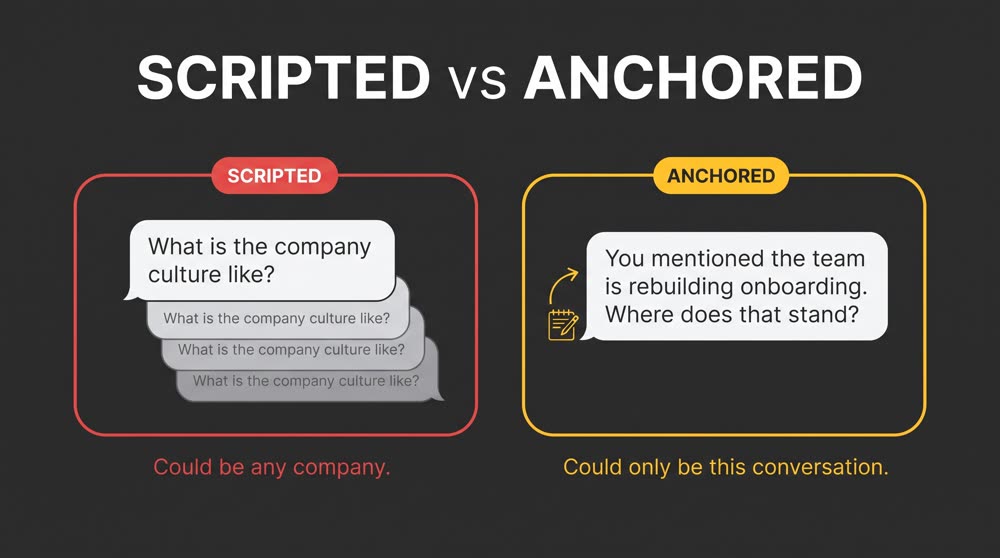
By 2026, nearly every candidate arrives with a generated list of questions. That's not a scandal, and it's not the problem. Getting a starting list from AI is genuinely useful preparation.
The problem is what happens when the list gets read out unchanged. Interviewers can't prove you used AI, and honestly most don't care. What they notice is the pattern that gives it away: the question references nothing that was said in the last hour, it would work for any company in any industry, or worst of all, it asks about something the interviewer already explained ten minutes ago. That last one is a signal you weren't listening, which is far more damaging than being unprepared.
The fix is simple and almost nobody does it. Take notes during the interview. When the manager mentions the team is rebuilding onboarding, or that the role exists because a project stalled, write it down. Then ask about that. A question that could only exist because of this specific conversation is worth more than five polished ones from a list.
Interviewers aren't grading you on where your questions came from. They're grading you on whether you were actually present for the conversation.
What to Do With This
Prepare six to eight questions. Keep two of them anchored to outcomes: what success looks like, and what separates good from great. Take notes during the conversation and let at least one question come directly from something they said. Hold salary and time off until there's an offer on the table. And if you sense hesitation from the panel, ask them about it directly before the call ends.
Then remember what you're actually doing in those last five minutes. You're not wrapping up. You're writing the sentence they'll put in the debrief.
Julee Tan is a career coach who spent years as a hiring manager, sitting on the other side of the table. Sources for this piece include SHRM, Coursera, BetterUp, Forage, and AWIS guidance published 2024 to 2026.