September 16, 2026
What Hiring Managers Actually Ask Your References
What hiring managers actually ask your references is one of the last true blind spots in the hiring process. You sit through the interviews. You get the email saying they would like to check a couple of references. You send over two names, you text those people a quick heads up, and then a conversation happens about you that you will never hear. Most candidates imagine it as a friendly chat. It is not a chat. It is a script, and I have worked from it many times.
Here is what is on it.
The Call Is Shorter and More Structured Than You Think
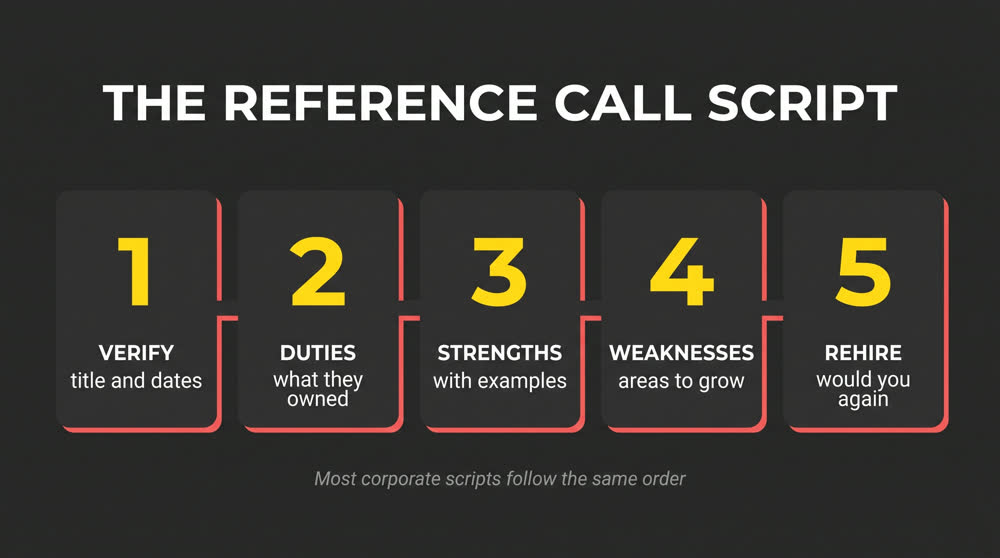
Most corporate reference scripts follow the same order, and the majority of the call is not about your brilliance. It opens with verification. What was their job title. What were the dates. How do you know them, and how long did you work together. Why did they leave. That is the boring part, and it is also the part that quietly catches people who rounded a nine month stint up to a year, or gave themselves a title that was never formally theirs.
Then it moves into duties. What did they actually own day to day. This one matters more than candidates realise, because it is where an interview story gets checked against a memory. If you described leading a project and your old manager describes you contributing to a project, nobody accuses you of lying. But the hiring manager hears the gap, and it costs you.
After that comes strengths, then development areas, then behaviour under pressure and with colleagues. Well-run scripts ask for examples, not adjectives. "Can you think of a time they went above and beyond" is a standard line, and so is "were there any behaviours that affected their performance, like missed deadlines or friction with colleagues."
Most of these calls run twenty minutes. The script barely changes between companies.
The One Question That Carries More Weight Than the Rest
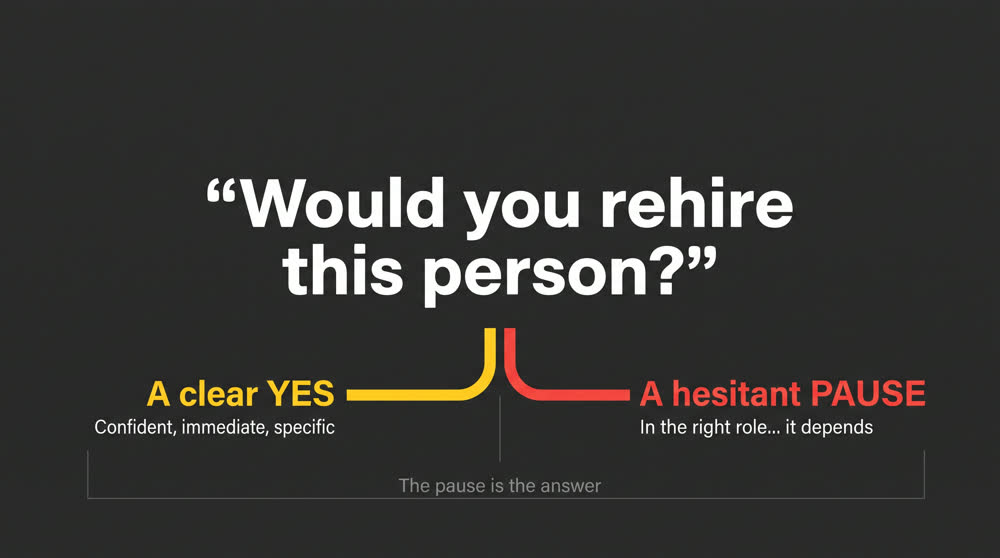
Near the end, almost every script asks a version of this: "If the opportunity came up, would you rehire this person?"
That question does more work than everything before it. It forces your former manager to compress a whole working relationship into a yes or a no, and it is very hard to fake. In my experience on the hiring side, the answer told me more than any list of strengths, because of how it arrived. A clear yes comes fast and comes with a reason. It sounds like "yes, in a heartbeat, I tried to keep her." That lands as a genuine endorsement.
What you do not want is the pause. The half second of silence, then "well, in the right role" or "it would depend on the team." Nobody has said anything negative. Nothing in that sentence could ever be quoted back. But every experienced hiring manager reads the hedge, and the hedge is the answer.
The second highest signal question is comparative. "How does this person compare to the best you have seen in that role." It forces the reference to place you in a ranking instead of handing out compliments, and vague praise falls apart under it. For senior roles there is a third: "have you seen them operate at the scope they are being hired into." That one is about readiness, and it is often where a strong candidate gets offered the job at a level below the one they applied for.
Your Old Employer May Be Allowed to Say Almost Nothing
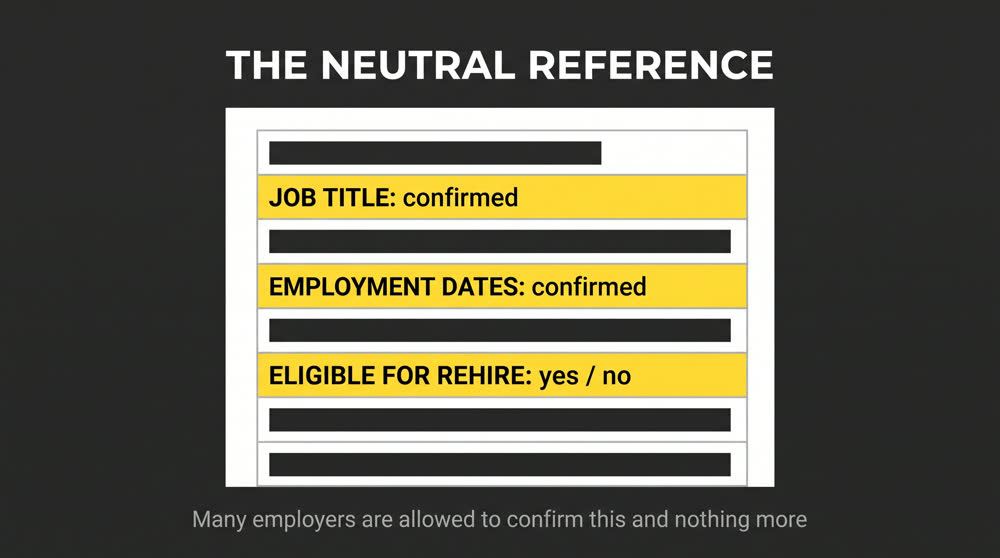
Here is the part that surprises people. Many companies have a neutral reference policy. Managers are told to route every reference call to HR, and HR confirms three things: your job title, your employment dates, and sometimes whether you are eligible for rehire. Nothing else. No performance commentary, no examples, no opinions.
This is a legal defence, not a comment on you. If a former employer says something false that damages your reputation, that is defamation exposure, so risk-averse organisations remove the judgement call from individual managers entirely. In the UK the framing is slightly different. There is generally no obligation to give a reference at all, but if a company does give one, it has to be accurate, fair and not misleading, which pushes many employers toward the same factual-only approach.
So if your old company says almost nothing, do not panic, and do not read it as sabotage. Hiring managers know what a policy wall sounds like. What is genuinely loud is a single field: eligible for rehire, marked no. That is a formal record, usually tied to a performance or conduct decision, and it travels. If you think that box may be ticked against you, it is worth knowing before an offer is on the table rather than after.
This is also the reason a former colleague or a manager who has since left the company is often a more useful reference than your old employer's HR line. They can speak. HR frequently cannot.
It May Not Be a Phone Call at All
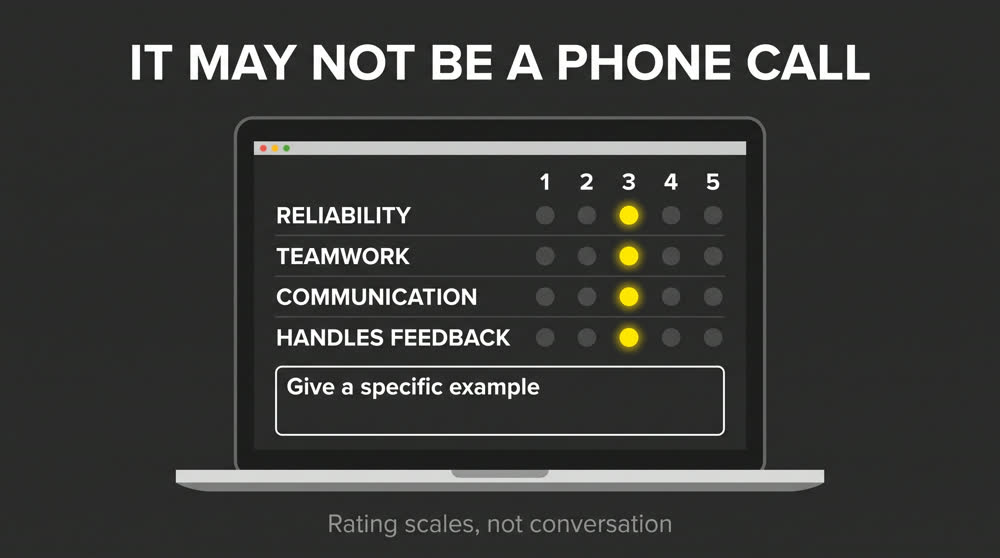
More and more, the reference check arrives as an email survey. Platforms like SkillSurvey, Xref and Checkster send your reference a structured questionnaire instead of booking a call, and the format changes the game.
Your reference is asked to rate you on specific competencies on a scale, things like reliability, teamwork, communication and how you take feedback, and then to give a written example for each. The employer gets back scores, sometimes benchmarked against other candidates, plus the comments. Two things follow from that. References often answer more honestly, because the process feels institutional rather than personal, and there is no hiring manager on the line to hear the hesitation. Nobody hears the pause in a survey. But the numbers sit there in black and white, and a row of threes where the rest of the form has fives is its own kind of hesitation.
The other practical consequence is timing. If your reference is slow to open that email, your offer sits still. I have seen final paperwork held up for over a week because one busy person did not get round to a ten minute form. Tell your references it is coming.
Brief Your References. Almost Nobody Does
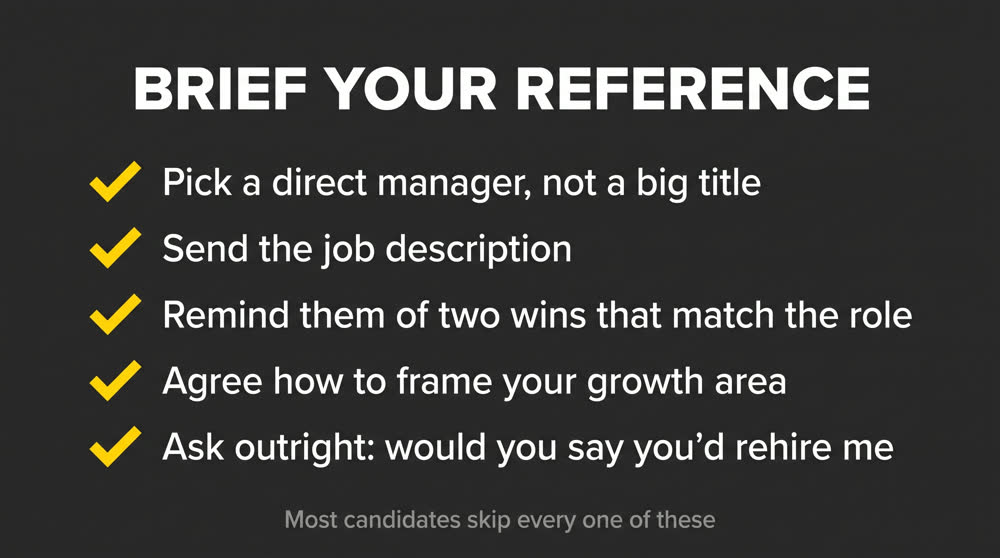
Most candidates send a one line text asking permission and leave it there. That is a wasted asset. You cannot control what your reference says, and you should not try, but you can absolutely make sure they are answering the real questions well.
Pick a direct manager from roughly the last five to seven years over an impressive name who barely saw your work. Most of the script assumes the person can describe your day to day. A senior title who has to improvise is worse than a team lead who remembers everything. If you are stepping up a level, include at least one person who has seen you handle that bigger scope, because that question is coming.
Then actually brief them. Send the job description and one line on what the role needs. Remind them of two specific wins that map to it, so that when they get asked for an example they reach for the right one instead of whatever surfaces first. Agree on how to frame a development area, ideally one you have visibly worked on, with what changed since. Every script asks about weaknesses, and an unprepared reference either invents something or says "none I can think of," which reads as evasive.
Last, ask the uncomfortable question directly. "If someone asks whether you would rehire me, are you comfortable saying yes?" If they hesitate with you, they will hesitate with the hiring manager. Better you hear it now, while you can still choose someone else.
Sources include the US Office of Personnel Management reference checking guidance, Rutgers University HR sample reference questions, Yale University's SkillSurvey reference process, BambooHR, Workable and Indeed reference check question guides, and Guardian Jobs recruiter guidance on UK reference practice.