September 5, 2026
What Hiring Managers Actually Look For on a Resume
What hiring managers actually look for on a resume is a far shorter list than most people think, and we work through it a lot faster than anyone would like to believe. I have sat on the other side of that stack many times. Two hundred applications, one afternoon, a role that needs filling by the end of the month. Nobody is savouring your document. We are looking for a handful of specific things, in a fairly predictable order, and if we find them you move forward.
The First Eleven Seconds, and What They Are Spent On
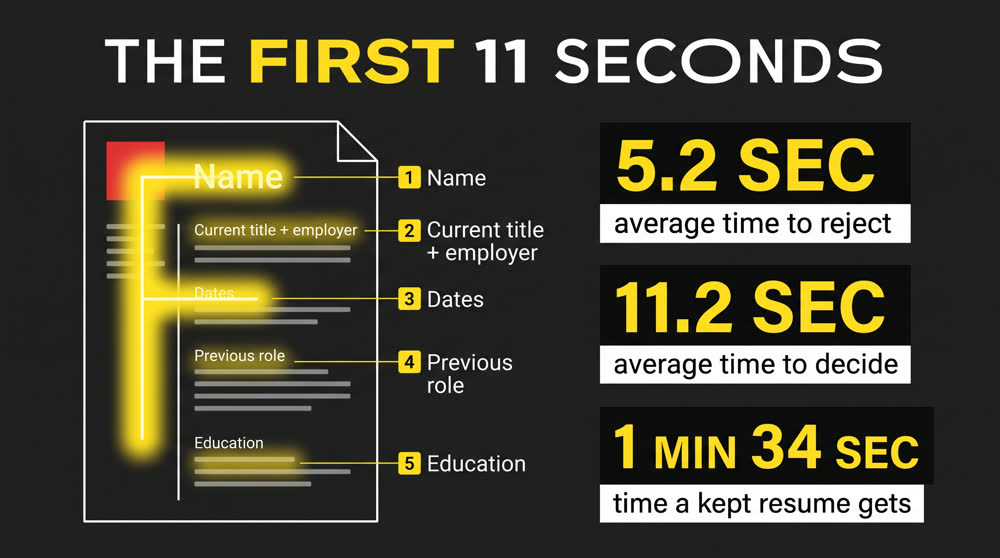
In one 2025 study of 4,289 real resume reviews across 312 recruiters and hiring managers, the average first pass before a keep or reject decision was 11.2 seconds. Rejections were faster still, averaging about 5.2 seconds. In a separate survey, 65 out of 100 hiring managers said they make that first call in under fifteen seconds.
That sounds brutal until you see what happens to the ones that survive. A resume that clears the first pass gets around a minute and a half of genuine attention. So the whole game is the opening seconds. You are not being judged in that window. You are being sorted.
Eye tracking research shows we all read a resume in roughly the same shape, a rough letter F. Name at the top. Current job title and employer. The dates next to it. Then the role before that. Education usually comes last, and often only after we have already decided to keep reading.
Which means the bottom half of page one is doing almost no work in that first pass, and page two is doing none at all. If the thing that makes you the right person for this job is sitting in the fourth bullet of your third role, I will probably never reach it.
The Four Things That Move You Into the Yes Pile
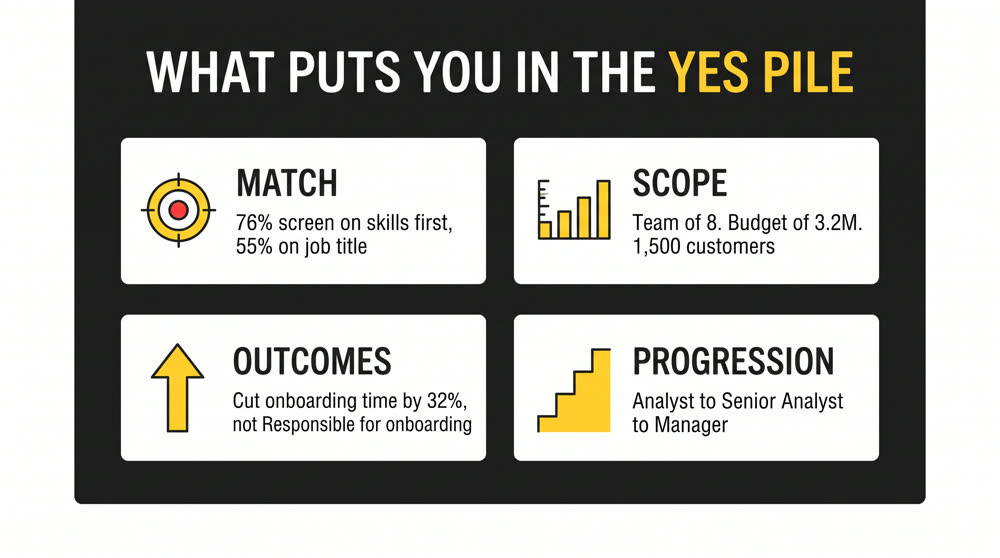
Match comes first, and it is blunter than you want it to be. In a 2025 survey of 384 recruiters, 76 out of 100 said they filter on skills keywords before anything else. 55 out of 100 filter on job title. 44 out of 100 filter on years of experience. If your current title and your skills section do not visibly line up with the posting, nothing further down the page gets a chance to rescue you.
Then scope. I am trying to work out whether you have operated at the size this role needs. A team of eight. A budget of three million. A product with fifteen hundred customers. Twenty three live projects. Numbers like these are not showing off. They are the only way I can tell the difference between someone who ran the thing and someone who was in the room while it happened.
Then outcomes rather than duties. "Responsible for onboarding" tells me what your job description said. "Cut onboarding time by 32 percent" tells me what changed because you were there. One of those is a title. The other is evidence.
Then progression. Analyst, then senior analyst, then manager. Or the same title three times with visibly bigger scope each round. I am reading your last three roles as a sentence about where you are heading. A flat line is not fatal, but it needs something in the copy to explain it, because otherwise I will fill in the blank myself and I will not be generous about it.
The Numbers That Land, and the Ones That Make Me Suspicious
Everyone has been told to quantify. Not everyone has been told that the wrong number is worse than no number, because it costs you trust rather than just space on the page.
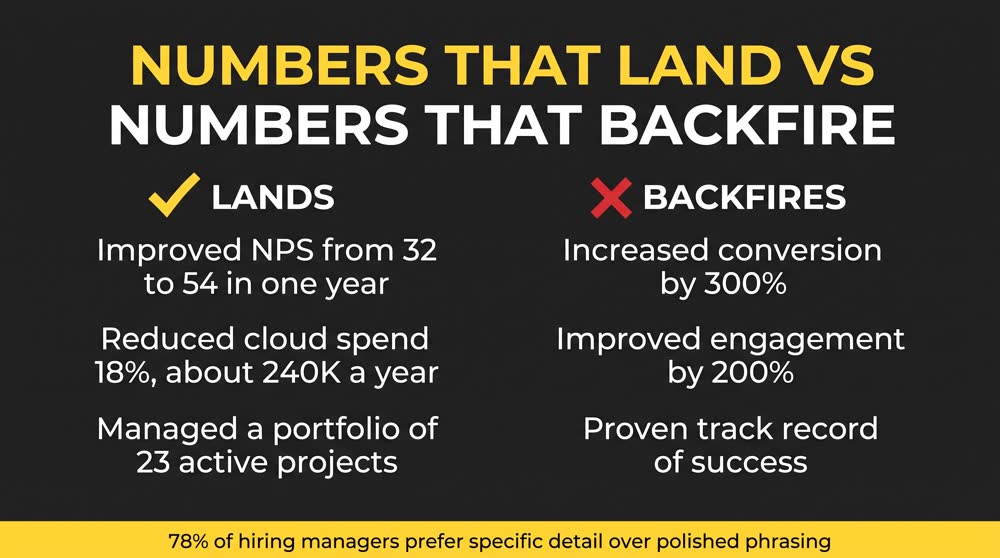
A number lands when I can picture the work behind it. "Improved our customer score from 32 to 54 in a year." "Reduced cloud spend by 18 percent, about 240 thousand a year." "Managed a portfolio of 23 active projects." Each of those has a starting point, an ending point, or a scale. I can ask you a sensible follow up question about any of them, and that is exactly the point.
A number backfires when it floats. "Increased conversion by 300 percent" with no traffic figure, no timeframe and no mention of what you actually changed reads as a rounding error dressed up as an achievement. When a claim is impressive and unverifiable at the same time, an experienced reader does not get excited. They get careful.
The pattern in the research is consistent. 78 out of 100 hiring managers say they would rather have specific personal detail than polished phrasing. The unglamorous, slightly awkward, obviously real number beats the beautiful vague one every single time.
The Fastest Way to Lose Me in 2026 Is to Sound Like Everybody Else
This is the part that has genuinely changed, and it is worth being precise about it, because the advice flying around online is mostly wrong.
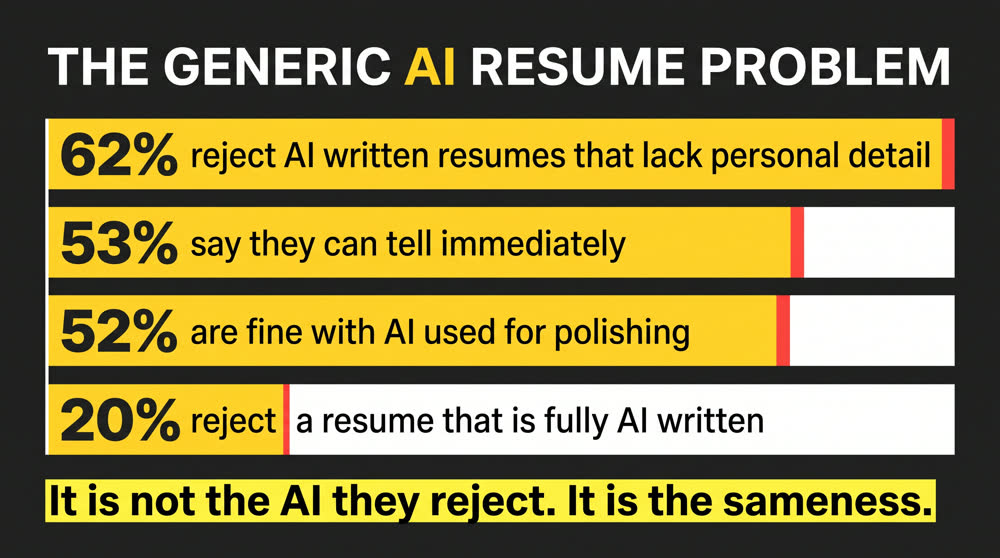
In a March 2025 survey of 925 employers, 62 out of 100 said they reject AI written resumes that lack personal detail. In a separate May 2025 survey of 600 hiring managers, about 20 out of 100 said they would reject a resume they believed was entirely AI generated. But in that same survey, 52 out of 100 said using AI to draft or tidy up your resume was completely fine. And 53 out of 100 hiring managers in another study said they can tell immediately when a candidate has used it.
Read those numbers together and the message is not "do not use AI." It is that we reject the sameness, not the tool. When four resumes in a row open with a results driven professional with a proven track record, they stop being four candidates and become one blur. The screening software, by the way, is not the one catching this. Applicant tracking systems do not detect AI writing. They match keywords and parse your layout. It is a human being who notices that your resume sounds like the last nine.
So use the tool for structure and grammar, then put back the things only you could have written. The odd specific number. The name of the actual system you migrated. The messy detail of what went wrong before it went right. That is the part that cannot be generated, and it is the part I am reading for.
The Recruiter and I Are Not Reading For the Same Thing
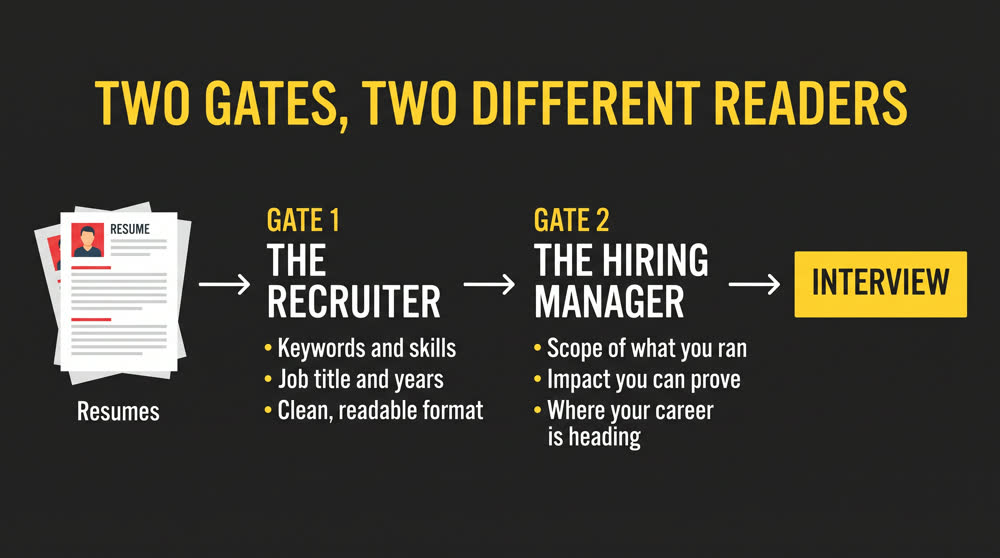
Here is the thing almost nobody accounts for. Your resume has to pass two different readers with two different jobs, and optimising for one can cost you the other.
The recruiter is managing volume and risk. They are checking keywords and skills, whether your title and years line up with the brief, and whether the document is clean enough to read quickly and parse correctly. Their job is to hand over a shortlist that is defensibly on spec. That is why a beautiful two column layout with graphics can quietly kill you. It is not that anyone dislikes it. It is that the system garbles it and the recruiter never sees your best line.
I am reading for something else entirely. I want the scope of what you have actually run, the impact you can prove and defend in an interview, and where your career is pointing. I am also quietly asking a question the recruiter is not paid to ask, which is whether you fill a gap this team currently has.
The practical version is simple. Build the top third of page one for both of us. Your title and level. Your domain. Two or three lines carrying real scope and a real outcome, with the language of the actual job posting used honestly rather than stuffed in. Get that block right and the recruiter passes you through on the keywords while I keep reading for the substance.
Most people who get passed over are not underqualified. They are unreadable in eleven seconds. Those are very different problems, and only one of them is about your experience.