August 25, 2026
What Hiring Managers Really Think About Job Hopping
What hiring managers really think about job hopping is a lot less moralistic, and a lot more calculated, than the advice you've been given. Nobody on the hiring side is judging your loyalty. They're doing arithmetic about risk. Here's what that arithmetic actually looks like from the other side of the table.
One Short Stint Is Not the Problem
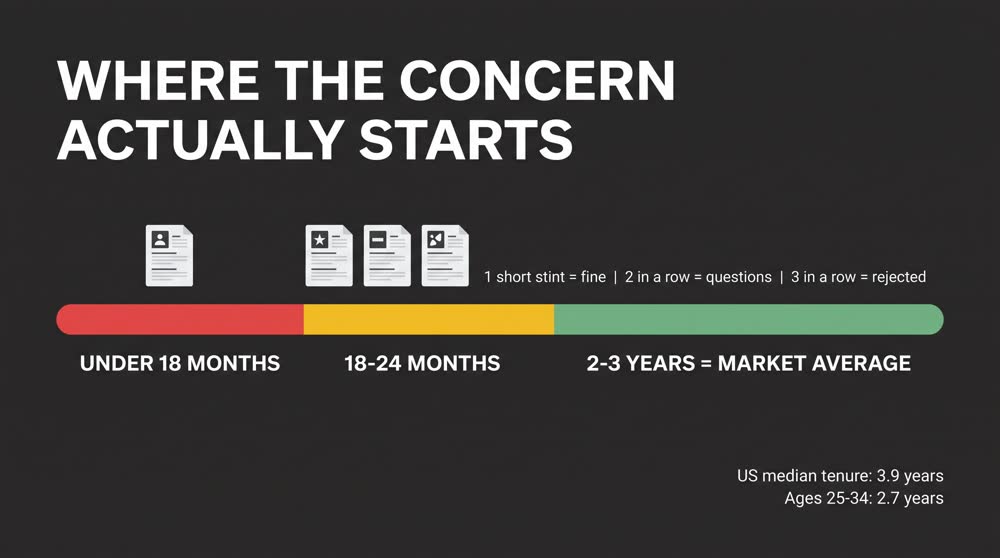
You're staring at your resume, counting the logos, wondering whether four jobs in seven years makes you look ambitious or unstable. Let me take the guesswork out of it. One short stint in an otherwise steady history barely registers. I read past those constantly. What made me slow down was a pattern: an average tenure under about 18 months, with two or three short roles sitting back to back and nothing on the page explaining why.
The surveys line up with what I saw in practice. Robert Half found that around 43 out of 100 hiring managers would pass on someone who'd held three or more roles in five years. In the US version of that survey, five job changes in ten years was the average point where a manager mentally files you under "job hopper." Notice that both of those thresholds are patterns, not single events.
Here's the part almost nobody tells you: the baseline has moved. Median tenure in the US is now 3.9 years, the lowest since 2002. For workers aged 25 to 34, it's 2.7 years, which is almost exactly what Baby Boomers were doing at the same age back in 1983. Two to three years per role isn't a red flag. It's the market average. The story that young workers are uniquely restless is a story, not data.
One caution, though. Roughly 4 in 10 recruiting teams admit to using automated filters that screen for short tenures, which means some resumes are sorted out before a person ever reads them. That's not a reason to panic. It's a reason to make your reasons visible on the page, which we'll get to.
It Was Never About Loyalty
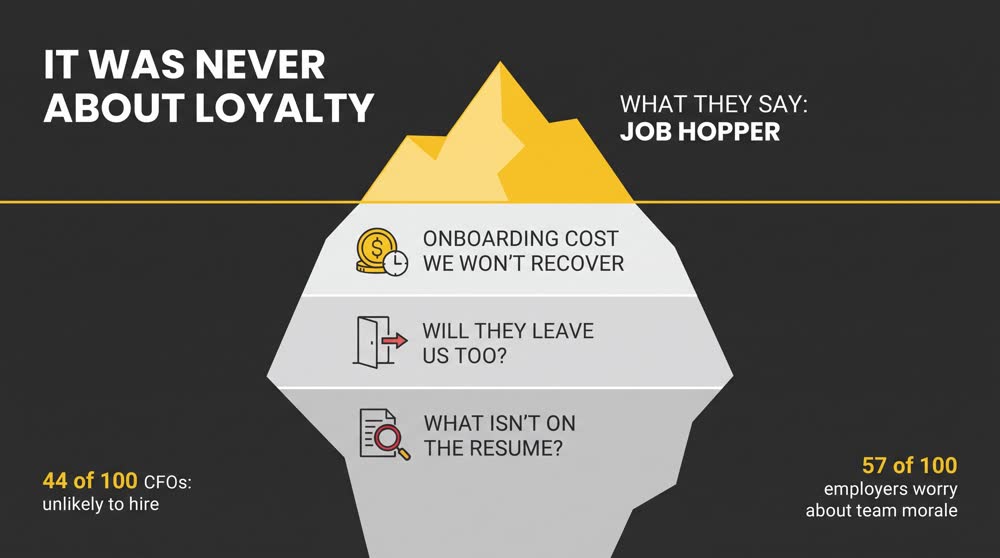
In all the hiring debriefs I sat in, I never once heard anyone say the word "disloyal." That's not the conversation. The conversation is about three very specific fears, and they're all about money and risk.
The first is onboarding cost. A new hire typically isn't fully productive for months. If you leave at month eleven, the team absorbed all of the cost and none of the return. That's why 44 out of 100 CFOs in one survey said they were "not at all likely" to hire someone with a job-hopping history, and why 57 out of 100 employers say churn damages team morale. They're not protecting a principle. They're protecting a budget and a team that just finished training the last person.
The second fear is simply "will they do it to us too?" A hiring manager is making a bet with their own credibility. If they push you through and you're gone in a year, that's their judgment on the line, not yours.
The third is the quietest and the most damaging: what isn't on the resume. When a short stint has no explanation attached, the reader fills the silence themselves, and people rarely fill silence with something generous. They wonder about a performance issue, a conflict, a probation that didn't get passed. None of that may be remotely true. It doesn't matter. An unexplained gap invites the worst available guess.
Which is actually good news. All three of those fears are answerable, and none of them require you to have had a different career.
The Raise You're Chasing Has Shrunk
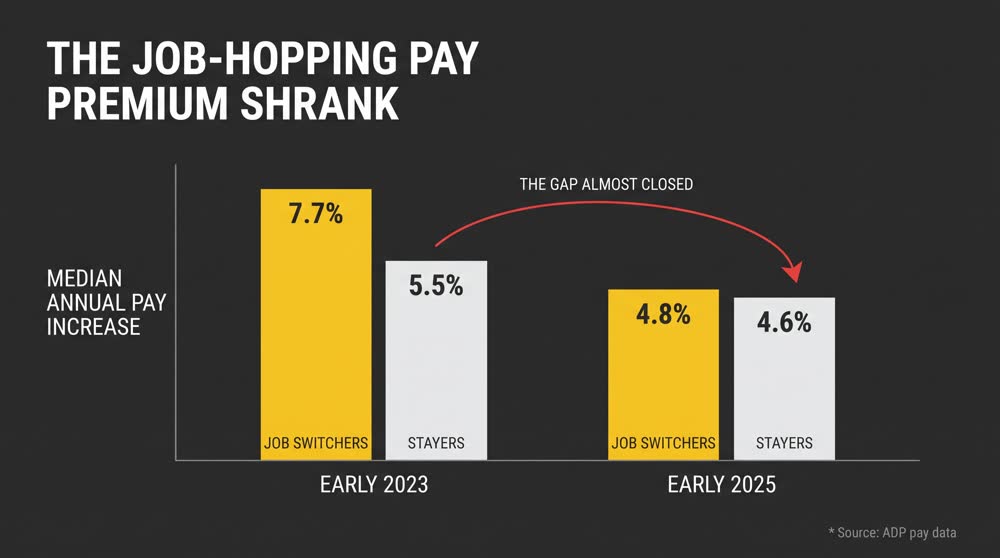
There's one more thing worth knowing before you make the next move, and it's the part that changed most recently. The math that made hopping obviously worth it has quietly collapsed.
Back in early 2023, people who switched jobs saw a median pay rise of about 7.7 percent, while people who stayed put got about 5.5 percent. Switching paid, clearly. By early 2025, the same data showed switchers at 4.8 percent and stayers at 4.6 percent. That gap is now small enough to be a rounding error. At the peak of the Great Resignation, moving could mean a raise of around 20 percent. By 2024 the median had already fallen to roughly 10 percent, and it kept sliding from there.
I'm not telling you to stay somewhere that's harming you. Lower-paid workers still see real gains from switching, and no salary bump is worth a job that's grinding you down. But if the only reason you're moving is the number, price that honestly now. You'd be trading a familiar system, a track record, and your credibility with people who already trust you for a difference that may be under half a percentage point.
How to Explain It So It Lands
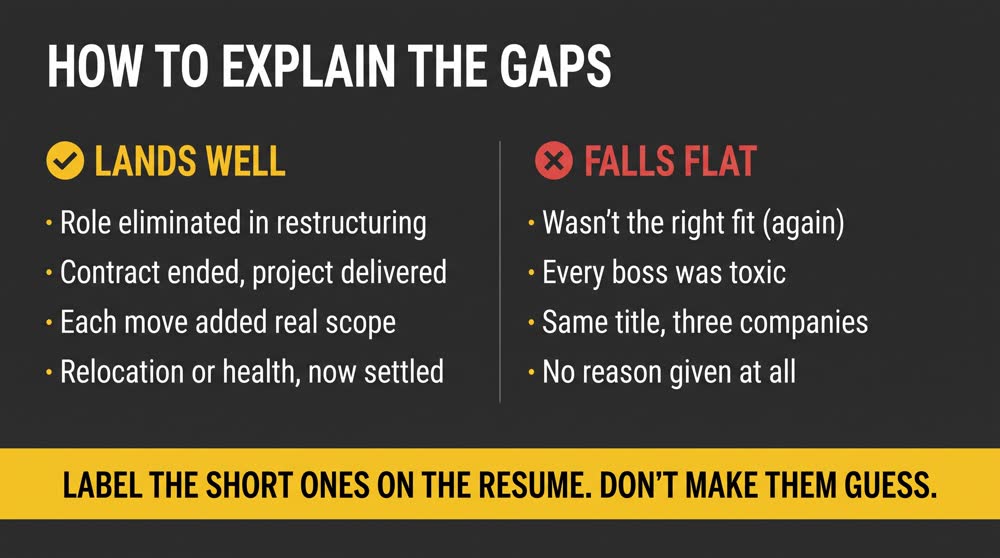
Hiring managers care far more about why than how often. Give them a why they can repeat to someone else, and most of the concern evaporates.
Explanations that land: your role was eliminated in a restructure. It was a contract and you delivered the project. You relocated, or dealt with a health or caregiving situation that's now settled. Or, best of all, each move visibly added scope, so the pattern reads as a climb rather than a scatter. Analyst to senior analyst to manager across three companies is a career. Three lateral moves at the same level is a question.
Explanations that fall flat: "it wasn't the right fit," repeated three times with no detail. Every previous boss being difficult. And worst of all, no reason offered at all, which sends the reader straight back to guessing.
The practical move is to stop waiting for the interview to explain yourself, because you may never get one. Label the short roles on the resume itself. A five-word note in brackets does it: "Contract, project completed." "Role eliminated in restructuring." You're not apologising, you're removing the question before it forms. Then, when you're in the room, connect the dots forward instead of defending backward. Say what each move taught you and why this role is the place that finally uses all of it.
Your job history is a story someone else is going to narrate in a meeting you're not invited to. The only real question is whether you handed them the narration, or left them to invent it.