July 29, 2026
What Really Happens in the Meeting That Decides Your Rating
Somewhere in the next few months, a group of managers is going to sit in a room and decide what you were worth this year. Your rating, your bonus, whether your name goes on the promotion slate. You will not be there. You will not know it happened until someone tells you a number in a one to one weeks later.
Most people think their performance review is the decision. It isn't. It's the submission. Here is what actually happens after you hit save on your self assessment, and what you can do in the months before it to change the outcome.
There Is a Meeting About You. You Are Not in It.
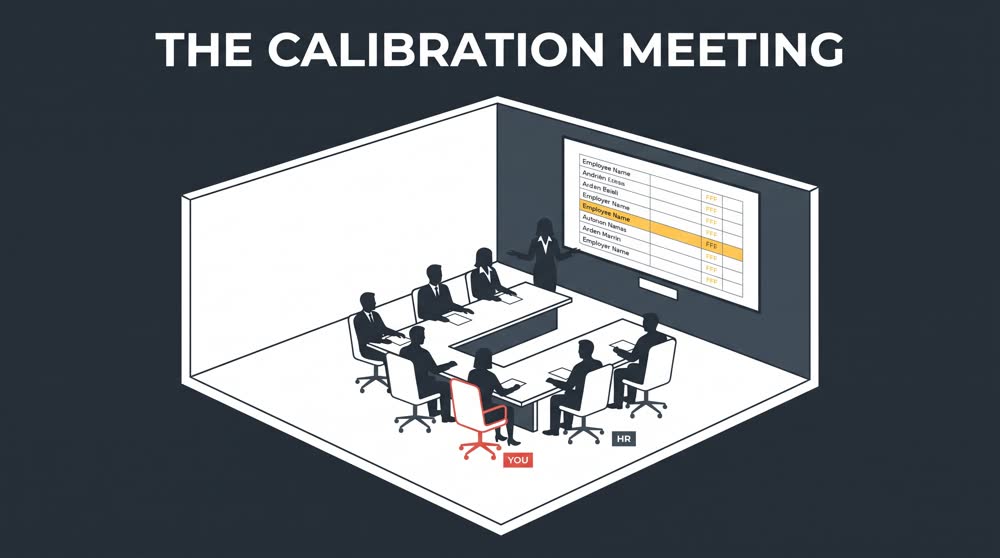
Every performance cycle at most large companies ends the same way. Your manager writes your review, attaches a proposed rating, and then walks into a room with the other managers at their level. HR facilitates. A second line leader usually sits at the head of the table. On the screen is a spreadsheet with every name in the org, the proposed rating beside it, and the manager who owns that name.
That meeting is called calibration. Some companies call it talent review. It is where your rating is actually set, and it happens after your review is written, not before. By the time your manager gives you a number, that number has already survived or lost an argument you never heard.
Here is the part almost nobody is told. Your review document is not the deciding evidence. It is the opening statement. What decides the outcome is the twenty to ninety seconds your name is on screen, when your manager has to say out loud why you deserve what they wrote, and seven other people decide whether they agree.
The Room Defaults to Average
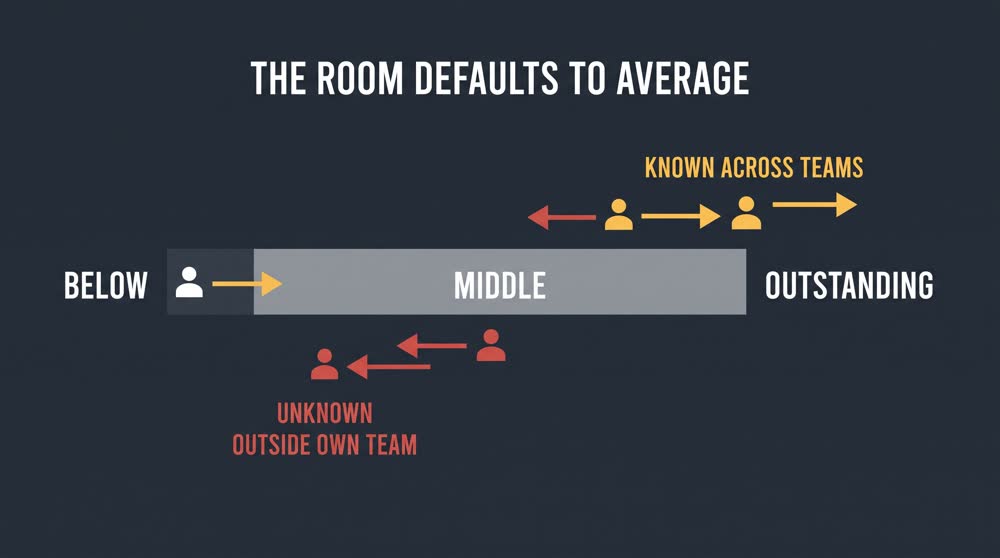
When your name comes up, one of two things is true. Either the other managers know your work, or they don't. If they don't, the room does not stay neutral. It slides you toward the middle.
That is not malice. It is arithmetic. A room of eight managers is trying to apply one rating scale consistently across a hundred people. When someone is put forward for a top rating and nobody outside their own team has a single concrete story about them, the group has no basis to place them above people it can see. So the rating comes down. HR logs the reason as insufficient evidence relative to peers. You hear "solid year, keep it up."
The most common cause of a strong performer getting downgraded is not a bad manager or a rigged system. It is a manager who walks in unprepared. If yours says "she works incredibly hard and has a great attitude" and can't follow it with an outcome, a number, or a name from another team, that rating will not survive the next three questions. Your manager loses the argument in under a minute, and you never find out it took place.
Low visibility work is the quiet killer here. Maintenance, cleanup, internal tooling, the unglamorous thing that keeps the business upright. The work is real. But if nobody translated it into business impact before the meeting, the room reads it as ordinary, and ordinary maps to the middle of the scale.
The Biases Sitting in That Room With You
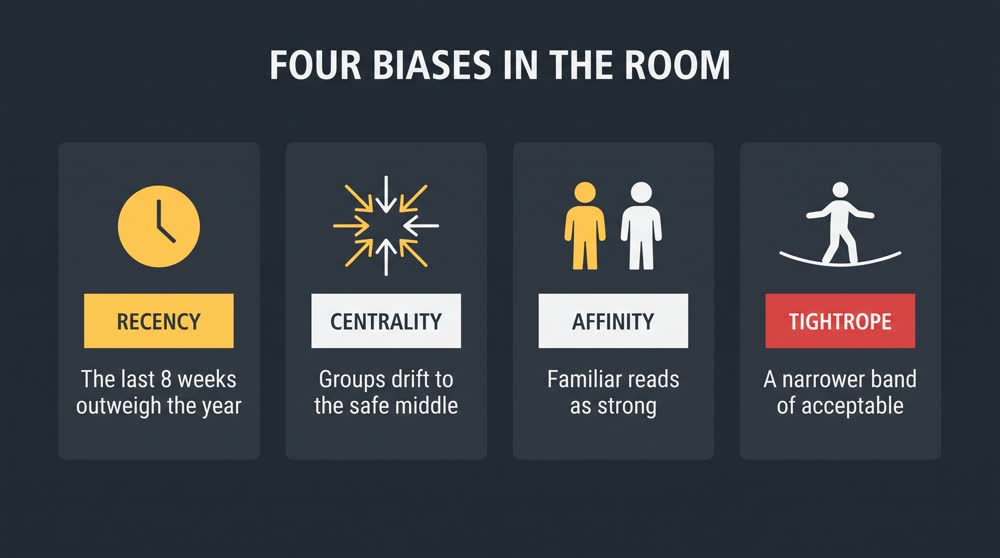
Most companies now open calibration with a slide on bias. It helps. It does not make bias disappear.
Recency bias costs people the most. A room that has been talking for two hours remembers what happened in the last eight weeks far better than what happened in February. If your best quarter was the first one, your manager is already fighting uphill.
Centrality bias is the second. Research from Korn Ferry found that calibration can actually make this one worse rather than better, because a group under time pressure gravitates to the safe middle to avoid conflict. Group discussion fixes one kind of unfairness, the manager who rates everyone too high or too low, and quietly creates another, where everyone drifts toward the same average.
Then there is what researchers call tightrope bias, the narrower band of acceptable behaviour applied to women and people of colour. Assertive reads as difficult. Measured reads as not ready. Because calibration is exactly where a room agrees out loud on what leadership looks like, it is also where that narrower band gets written into someone's rating.
The honest version of the picture in 2026: formal forced ranking curves have largely gone away, and that is real progress. But plenty of companies still carry soft guidance, something along the lines of "we'd expect only ten to fifteen out of every hundred people to be outstanding." A curve you are not allowed to call a curve still behaves like one.
What Actually Moves a Rating Up
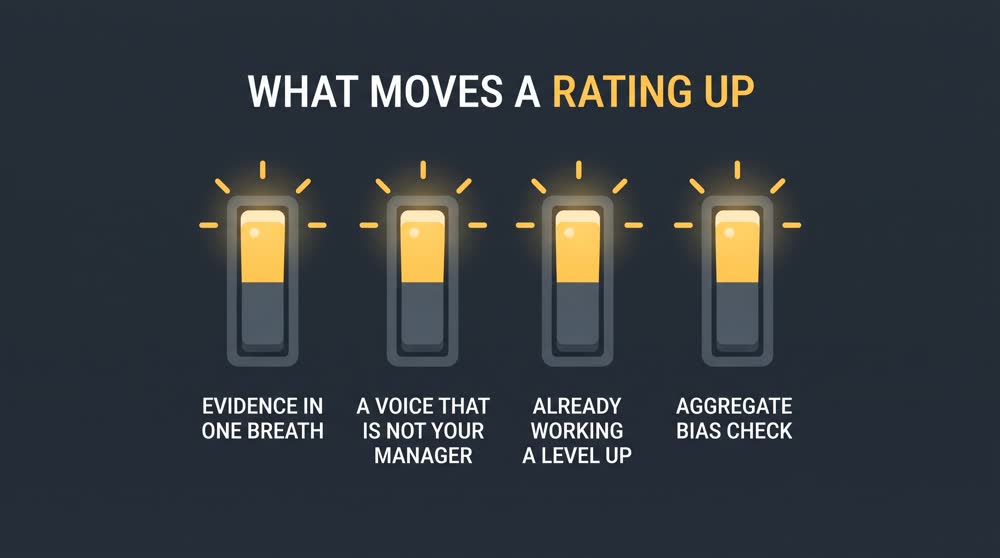
Ratings go up in that room too. It happens for very specific reasons, and none of them are effort.
The first is evidence your manager can deliver in one breath. Not "led the migration project" but "led the migration, cut processing from six days to two, and finance stopped running their manual reconciliation because of it." Specific, external, checkable. Rooms move toward things they can verify.
The second is a voice that is not your manager's. When a manager who does not own you says "I've worked with them, they unblocked my team twice this year," the debate ends there. That one sentence outperforms three paragraphs of your self assessment, because it comes from someone with no incentive to inflate you. This is the entire reason cross functional visibility matters more than the polish on your review document.
The third is a narrative that you are already operating a level up. Not that you did your job well, but that you did work the next level is expected to do. Leading without authority, mentoring, making a call that carried consequences past your own team. Promotions get argued on that ground, not on volume of output.
The fourth is rarer and worth knowing about. Some companies now run an aggregate check at the end of the session, looking at how ratings landed by gender, level and location. When a pattern shows up, borderline cases get reopened. It is not a fix, but it is the reason being borderline is not automatically bad news.
The Work Happens Before the Meeting, Not In It
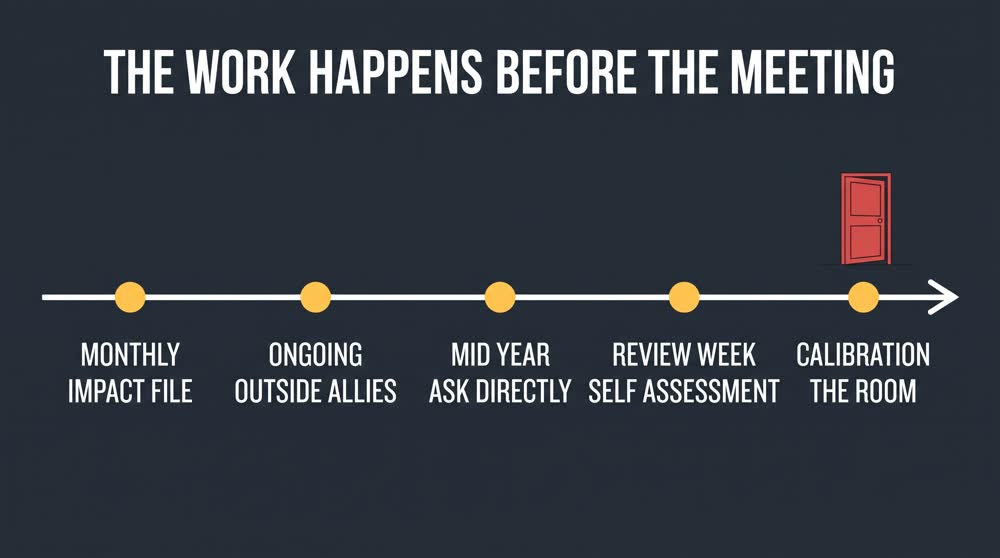
You cannot attend calibration. You can change what gets said there. All of this has to happen in the months before, not in review week.
Keep a running impact file. One document, updated monthly, with what you delivered, the number attached to it, and who benefited. Write it in business language, not task language. When your manager sits down to write your review, they will lift your sentences straight out of it. Most managers are writing eight reviews in a weekend. The person who handed them the receipts gets the strongest write up, every single time.
Get known by at least two managers who are not yours. Volunteer for the cross team project. Answer the question in the other team's channel. Present at the review that includes their org. You are not networking. You are placing a witness in the room.
Ask the direct question at mid year. "If the cycle ended today, what rating would I get, and what specifically would you need to see for the next one up?" Ask it in a one to one, then send a short summary by email afterwards. You have now turned a vague expectation into a written target, and given your manager an obligation to have an answer.
Write your self assessment as your manager's script. Don't use it to be modest and don't use it to inflate. Use it to hand them the exact three sentences they need to defend you when the room pushes back. Tie each one to the level definition you are being rated against.
Find a sponsor, not just a mentor. A mentor gives you advice in private. A sponsor says your name in a room you are not in. Only one of those changes your rating.
None of this is about playing politics. It is about understanding that the decision gets made by people who mostly cannot see you, working from whatever your manager can carry into that room. Your job, all year, is to make sure they walk in carrying something worth saying.