July 16, 2026
Why Internal Candidates Lose Promotions to Outside Hires (And What Gets You Chosen Instead)
You put in the years. You know the job better than anyone external ever could. And then the role opens up, and it goes to someone who's never even worked at your company.
If that's happened to you, you're not imagining a pattern. Promotions are genuinely harder to come by right now, and even when they do happen, internal candidates lose out more often than most people realize. Here's what's actually going on in the room where that decision gets made, and what separates the people who get chosen from the people who don't.
The Promotion Drought
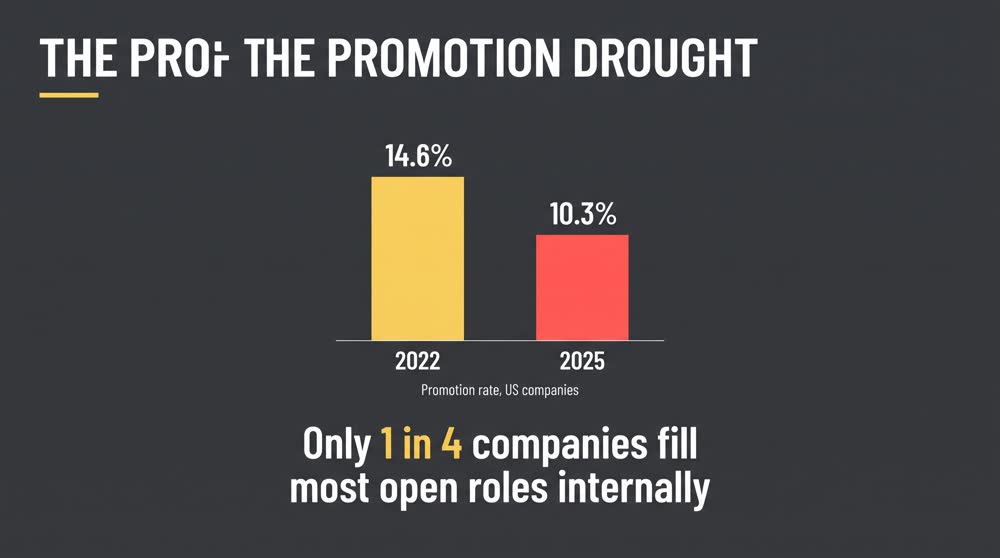
Promotions have quietly gotten a lot scarcer. Back in 2022, during the hiring frenzy that followed the pandemic, roughly 15 out of every 100 employees at a typical company got promoted in a given year. By 2025, that number had dropped to about 10 out of 100, a five-year low. Some benchmarks put the "healthy" promotion rate even lower, closer to 6 out of 100.
It's not just that promotions are rarer. Companies are also less likely to look inside their own walls to fill a role in the first place. Only about 1 in 4 companies fill most of their open positions with internal candidates. The other three out of four default to hiring from outside, even when they have someone qualified sitting right there.
So if you've been quietly filed under "not this time" more than once, you're up against a structural headwind, not just a personal shortcoming.
Your Company's Culture Quietly Decides Your Odds
Here's something most people never think to check: your odds of getting promoted depend heavily on which company you happen to work for, separate from how good you are at your job.
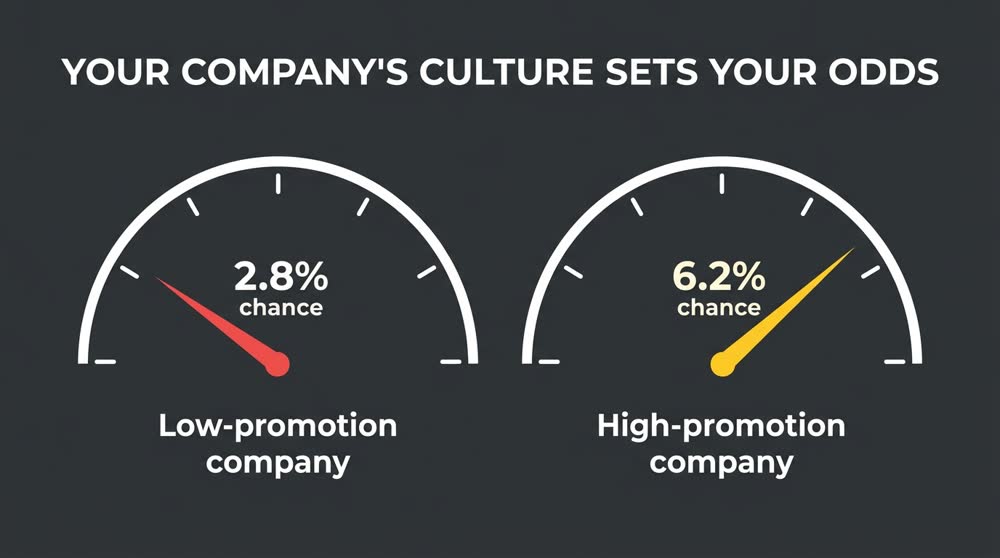
Research tracking large companies found that employees at low-promotion companies have roughly a 2.8% chance of getting promoted in the next year. At high-promotion companies, that number jumps to 6.2%, more than double, for comparable talent. Some companies promote 10 to 12 people out of every 100 each year. Others promote just 1 to 3.
That gap isn't random. It reflects a durable culture. Some organizations are simply built to develop and advance people, and others aren't, no matter how good those people are. If you've been grinding at a low-promotion company for years, the math was working against you before you ever walked in the door.
Why "Ready" Doesn't Always Mean Chosen
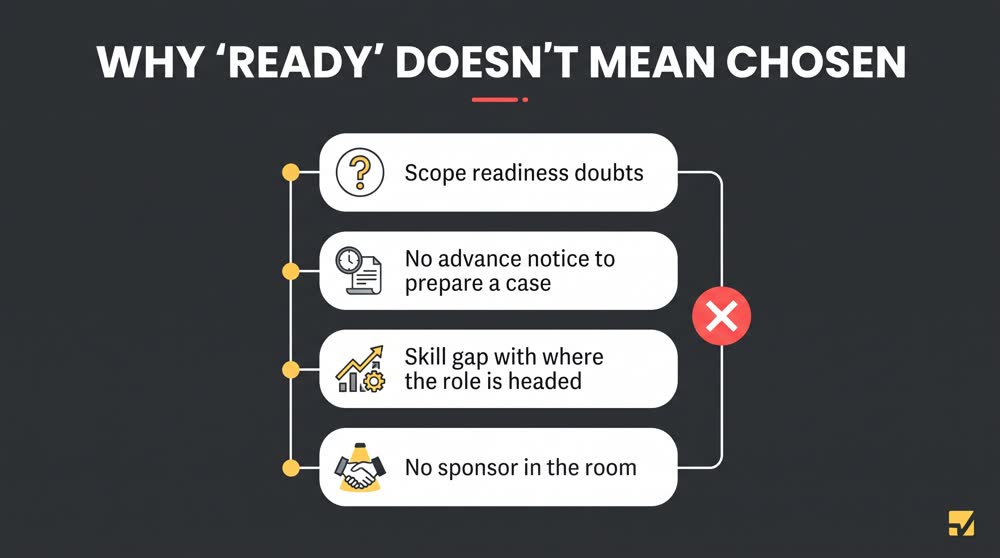
From the hiring-manager side of the table, "no" to an internal candidate almost never means "you're not good at your job." It usually comes down to one of a handful of quiet disqualifiers:
Scope readiness doubts. Being excellent at your current job is not the same as being trusted to own a bigger, messier one. Managers aren't asking "are they good at what they do?" They're asking "can they handle a problem set that doesn't have clean edges yet?"
No advance notice. Internal roles often get posted with almost no warning, leaving little time to build a real case. External candidates show up with a polished narrative because that's the entire point of a job search. Internal candidates rarely get the same runway to prepare.
A skill gap with where the role is headed. Managers are promoting for where the job is going, not where it's been. If your skills map well to today's version of the role but not the next three years of it, that's a real strike against you.
No sponsor in the room. This is the big one. When the decision gets made, you are not there. Someone else has to make the case for you, and if nobody with influence is actively advocating for you, you are effectively invisible at the moment it matters most.
What the Chosen Ones Do Differently
The employees who do get promoted from within aren't just working harder. They're doing a few specific things that most people never think to do.
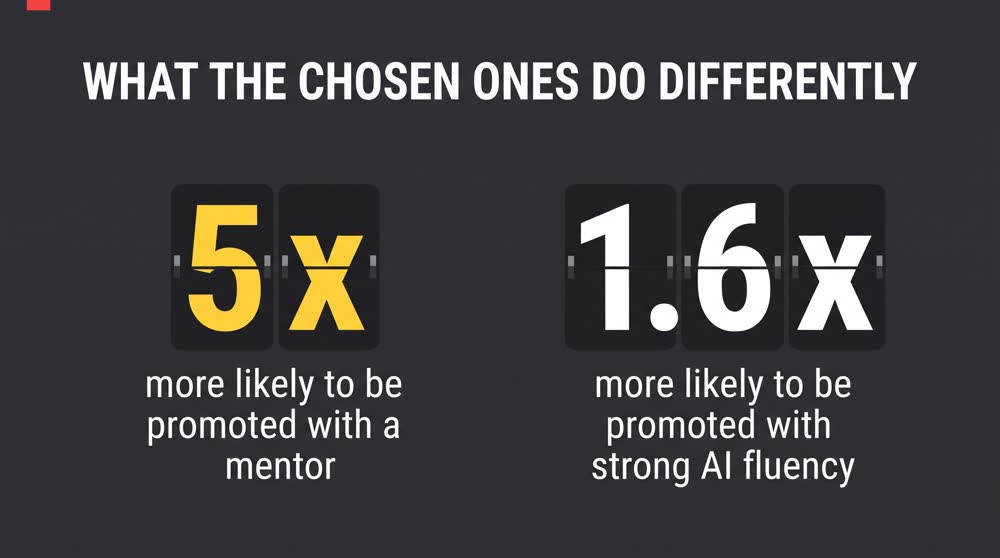
They have a mentor or sponsor. One well-known internal study found that employees with a mentor were promoted five times more often than those without one, and the mentors themselves were promoted six times more often. Having someone senior who knows your work and will vouch for you when you're not in the room is one of the single biggest levers available.
They demonstrate skills the company actually needs next, not just the skills the current job requires. Employees who show strong AI fluency, for example, are about 1.6 times more likely to be promoted than peers who don't.
They manage up deliberately. That means regularly translating their work into terms leadership cares about (revenue, risk, efficiency) and making sure their manager and other decision-makers already know they want the next step, well before a role opens. By the time the opportunity appears, their case has already been made.
They build visibility outside their own lane. People who get promoted into senior roles overwhelmingly have experience that crosses team or department lines, not just deep expertise in one narrow area.
Why Companies Still Hire Outside Despite the Math
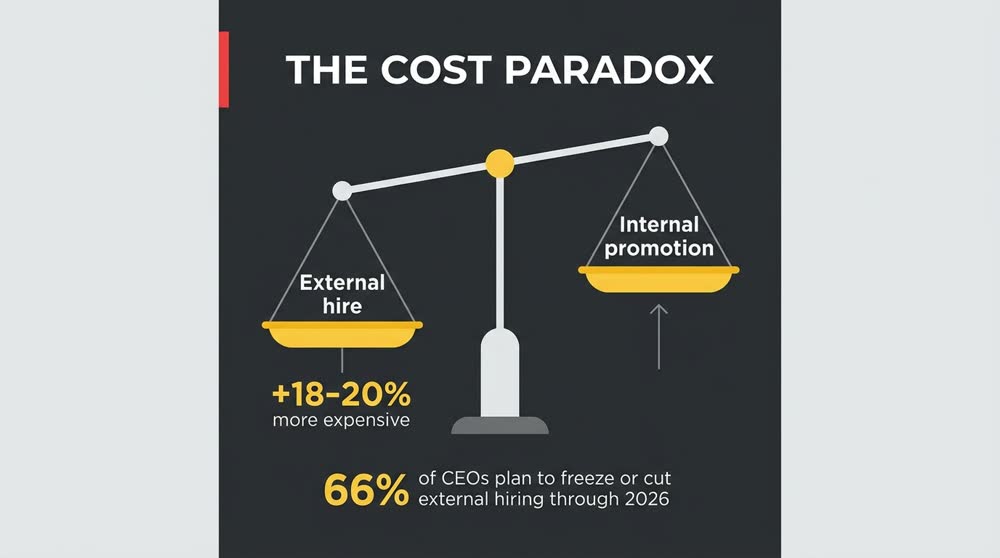
Here's the part that should actually give you hope. Hiring externally costs a company roughly 18 to 20% more than promoting from within for the same role. That's a well-documented finding, not a guess, and companies know it.
And yet, even with that cost gap, a majority of CEOs (around 66%) say they plan to freeze or cut back on external hiring through the rest of 2026. Budgets are tightening, and leadership is under real pressure to justify every hire.
What that means for you: the financial incentive to look inward is only getting stronger. Companies that have been defaulting to outside hires are increasingly boxed in by their own budgets. If you position yourself as the obvious, lower-risk, lower-cost choice (with a sponsor who can say so in the room), you are pushing on a door that's already starting to open from the other side.
The gap between "solid performer" and "the person who gets promoted" usually isn't talent. It's whether someone senior is in your corner, whether your skills point toward where the company is headed, and whether you've built your case before the role ever opens. That part is entirely in your control.