July 30, 2026
Why You Hear Nothing After a Great Interview
You walked out knowing you nailed it. The conversation flowed, your examples landed, and someone on the panel said they were excited. Then the days started stacking up and nobody said anything at all.
Almost everyone reads that silence as a verdict. From the other side of the table, it usually is not one. Here is what is actually happening inside the company while you are waiting, why nobody sends the two-line email that would fix it, and the three things you can genuinely control.
The Silence Feels Personal. It Almost Never Is.
You left the room and you knew. The rapport was easy, your examples landed, and the hiring manager said something like “we are really excited about you.” You went home and told someone about it.
Then Monday came. Then Friday. Then the Monday after that. Nothing.
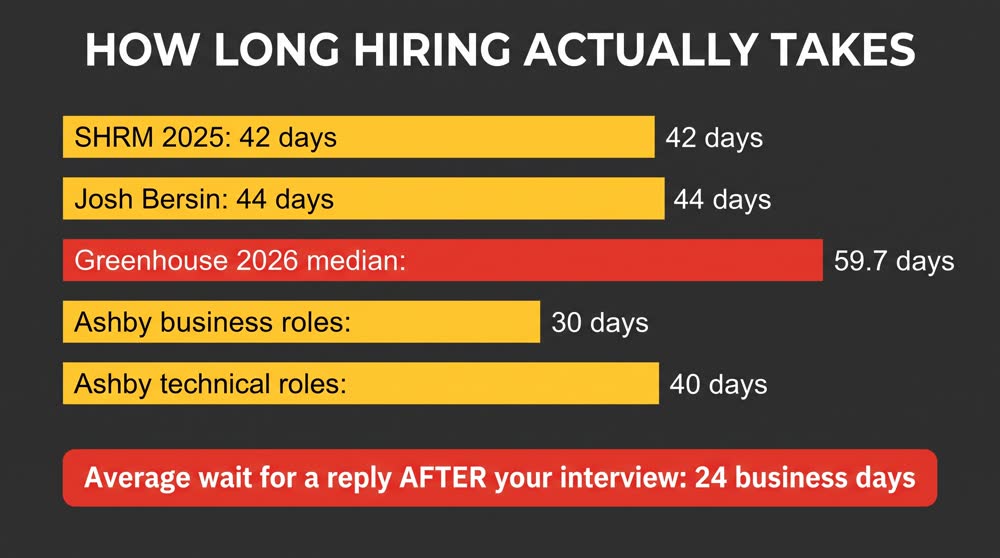
Here is what most people never get told. Indeed’s research found the average wait for a reply after an interview is 24 business days. That is close to five working weeks. Only about 37 out of every 100 candidates hear anything within a week, and Aptitude Research found 40 out of every 100 waited more than two weeks just to get any response at all after interviewing.
The whole process is also slower than it used to be. SHRM’s 2025 benchmarking put the average hire at 42 days from the day the role opened to the day someone accepted. Josh Bersin’s research lands at 44 days globally. Greenhouse’s 2026 data is worse again: their median time to fill a role is now just under 60 days, up from about 44 days in 2022. The process did not get more thorough. It got more clogged.
So when you are sitting on day 11 of silence, running the numbers on what you did wrong, you are usually inside a completely normal timeline that nobody bothered to explain to you.
8 Things That Stall a Hire After You Leave the Room
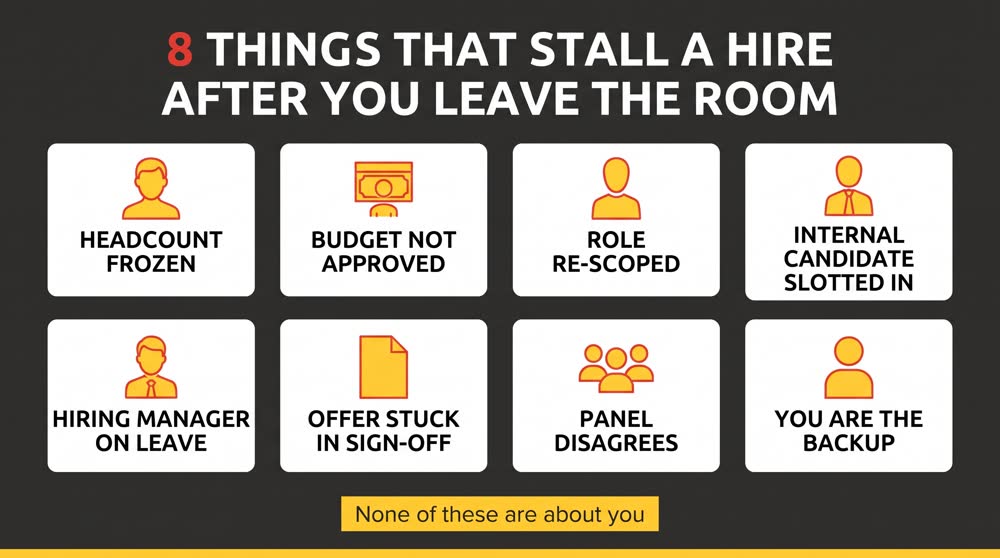
“They are just busy” is not a satisfying answer, so let me be specific. Here is what actually happens after a panel says yes.
The headcount gets frozen. A quarter closes badly, or a reorganisation starts, and every open role goes on hold. Nobody tells the candidates, because officially nothing has been cancelled.
The budget is not approved yet. The panel can agree on you completely and still not be able to make an offer, because finance has not signed off the salary or the funding for the role.
The role gets re-scoped. Priorities shift, and suddenly the team wants a more senior version, or wants to split the job in two. You interviewed for a role that no longer exists in that shape.
An internal candidate appears. Someone inside the business puts their hand up, or a manager moves a person sideways. External candidates go quiet not because they failed, but because they became unnecessary.
The hiring manager disappears. Annual leave, a new role, parental leave, a resignation. When the person driving the decision steps out, the process idles until someone else picks it up.
The offer gets stuck in sign-off. Approval often needs the manager, the manager’s manager, HR compensation review, and finance. One slow inbox anywhere in that chain freezes everything behind it.
The panel does not actually agree. In the room, everyone nods. In the written feedback, two people rank a different candidate first. Resolving that takes real time, and nobody is going to tell you it is happening.
You are the backup. This is the hardest one. Teams often have a first choice and a strong second, and they will not release the second until the first has signed. You are not rejected. You are being held.
Why Nobody Just Tells You
Fair question: even if all of that is true, why can nobody send a two-line email?
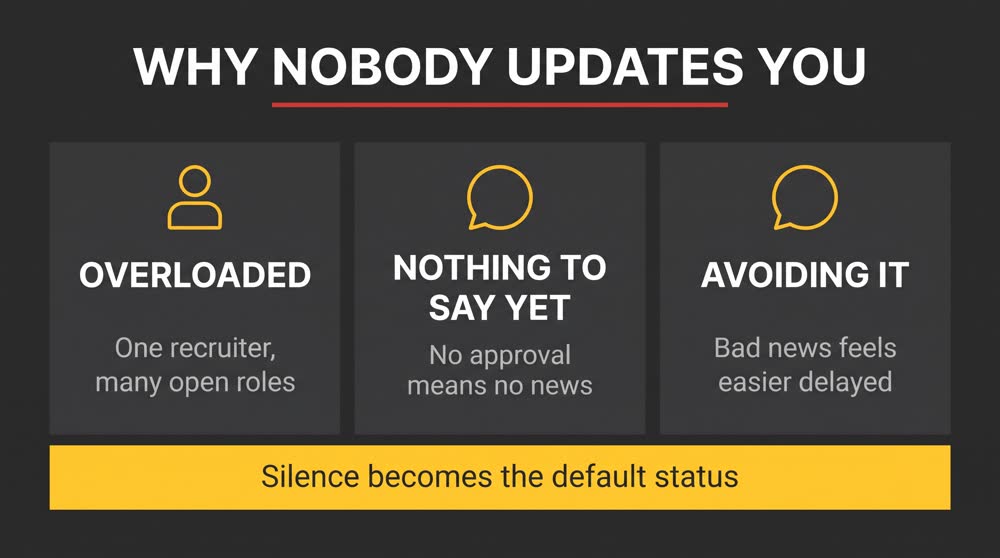
Three reasons, and none of them are as sinister as they feel. First, recruiters are usually running many open roles at once, and candidate communication is the first thing that slips when the day is full.
Second, and this is the big one, they often genuinely have nothing they are allowed to say. Until an approval lands or the first choice responds, any update would be a guess, and a guess that sounds like a promise creates a problem for them. So they say nothing, which feels like an answer but is not one.
Third, the human part. Telling someone capable and likeable that they did not get it is uncomfortable. Delaying it feels easier. Multiply that across a busy week and “I will do it tomorrow” quietly becomes three weeks.
Put those together and silence becomes the default setting. Not a decision, not a message, just what happens when nobody’s job description says “keep the candidate informed.”
What to Do in the Quiet
You cannot control their approval chain. You can control three things.
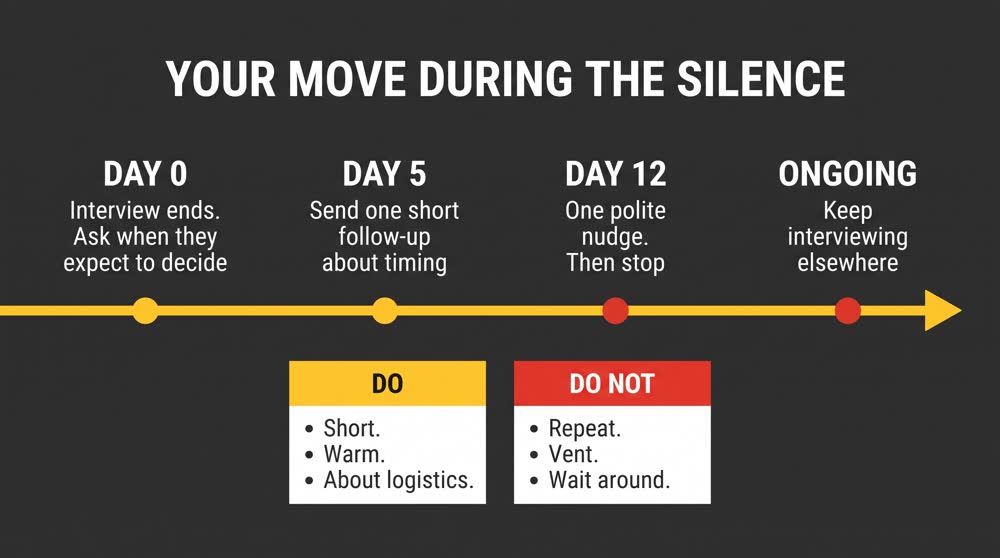
Ask for the timeline before you leave. The most useful question at the end of an interview is a logistics one: “What is your timeline for making a decision, and when should I expect to hear from you?” Now the silence has a shape, and you know whether day 10 is early or late.
Follow up once, at about five business days, and keep it boring. Short, warm, and about logistics. Something like: “Thanks again for your time last Tuesday. I am still very interested in the role. Is there any update on your timeline?” That is the whole message. No explanation demanded, no anxiety in the wording. Following up like that does not hurt you. What hurts is following up repeatedly, or letting frustration into the text. One nudge reads as interested. Four reads as hard to manage.
Treat “we will be in touch” as nothing at all. It is not a timeline. Unless someone gave you a specific date, no commitment was made. And treat a silent employer as what it is, which is not an offer. Keep applying, keep interviewing, keep every other conversation warm until you have something in writing. People lose weeks of momentum guarding a job they were never actually told they had.
If a month passes with nothing, you have your answer, and it still probably was not about you. Send one short note closing the loop, stay pleasant, and move on. Backup candidates get called weeks later far more often than people realise, and the person they call is the one who stayed easy to deal with.
Sources: SHRM 2025 Recruiting Benchmarking Report; Greenhouse 2026 Hire Standard; The Josh Bersin Company; Ashby 2026 Talent Trends; Indeed post-interview response research; Aptitude Research via StandOut CV.